Showing posts with label DNA. Show all posts

Monday, September 08, 2025

Does life begin at conception?

Okay, let's break this down. The most common thing I hear about a fertilized egg being a "person" and how life "begins at conception" is this argument that "it's a living thing in a woman's body that has different DNA". There's a big problem with this.

That's also an apt description of a cancerous tumor, or a parasite. If this is really what you have as your argument, then you are effectively arguing that we shouldn't treat cancer and we shouldn't try to remove a parasite. Is that what you want?

"But the 'unborn baby' has human DNA!" you respond. Yes, this fertilized egg has human DNA, but do you really want to call anything with human DNA a "person" and claim that killing it is "murder"? Biologists and doctors estimate that fully half of all fertilized eggs fail to survive nine months for purely natural reasons, most of them from simply failing to implant. That means that every time you have unprotected sex and the woman is fertile, there's a 50% chance that you are committing murder. All that "trying to have a baby" stuff? You're a serial killer.

Oh, it gets worse. So much worse. You know what else is alive in a woman's body that has different human DNA? Egg cells. They're alive, and each one is a potential baby. If you're a woman who has a menstrual cycle, once a month your body releases one (at least, could be more; I have fraternal twins) egg cell, which has about 24 hours to live and get fertilized. Every time you ovulate and you don't get pregnant, you've committed murder, at least according to your logic. It was alive, with its own human DNA, and you murdered that "unborn baby".

But of course, it's so much worse for men, because, according to the internet, "A healthy adult male can release between 40 million and 1.2 billion sperm cells in a single ejaculation." Each one is a living thing with its own unique human DNA, and how many will actually end up fertilizing an egg? This isn't murder, it's fucking genocide. Hundreds of millions of "unborn babies" with every single ejaculation.

Is this ridiculous? Yes it is.

Now those of us who are a little more sane about these things say that saying a fertilized egg is a person is like saying throwing a couple eggs with flour and sugar in a bowl is a cake. A cake and a person are both things that start with certain ingredients, but take time and a process in order to be complete. A bag of flour is not a cake. Flour, sugar, and eggs in a bowl is not a cake. Flour, sugar, and eggs mixed together in a cake pan and set in a cold oven is not a cake. That cake pan ten minutes later in a warm oven is still not a cake. It's not a cake until it has spent the full time at the full temperature in the oven and has been taken out. Then, and only then, is it a cake.

So it is with a baby.

Friday, January 30, 2009

Little things mean a lot

A lot of my ideas for things to write about come to me when I'm in the shower for some reason. Most of the time it's random, but occasionally, it actually has to do with the act of showering. There I was scrubbing away at my stomach and chest and thinking about something I read in an article somewhere about how essentially our bodies are a horrid mess of bacteria from our navel to our knees because that's where our intestines are, and they are the storehouse for some of the most powerful bacteria we have.

Actually, I think about this a lot, but suddenly I made a connection to another article I had read. You see, while it's true that there's a lot of bacteria in our intestines, we really have a lot of bacteria overall, and in fact I had read that scientists are now saying that the human body contains more bacteria cells than human cells. That's something to think about. Really, historically we've thought of bacteria as some sort of invader of the human body when in reality, we're living in a symbiotic relationship, for the most part.

And they are really a part of us. One researcher came to the conclusion that some people suffering from obesity are really having a hard time dealing with what are profoundly hungry bacteria that keep sending out hormonal messages to the brain, saying "FEED ME!" How else do you suppose our lives are affected by these microscopic life forms?

Then the thought took off, and I made the connection with another article I'd recently read, which is saying that biologists are starting to rethink the validity of Lamarckism. Lamarckism is the idea that things that an organism does in its lifetime has an effect on its offspring in a way that carries on through generations, sort of like a variety of fables about how a particular animal did some action, and that's why hippos have wrinkly skin, or rats have smooth tails. For some time, biologists had pooh-poohed the concept of Lamarckism, saying that it was our genes that define us. What if they're only "sort of" right?

Think of those hungry bacteria causing obesity. Maybe scientists are looking at the genes of obese people looking for a genetic marker for obesity, and they just can't find it...but it turns out they were looking in the wrong place? Perhaps it's not the genes of the humans that causes obesity, but the genes of the bacteria they carry.

If this were so, could there be more to it than that? No article this time (not that it matters, as I'm giving no references), but I have noticed, like several people, that married couples seem to sometimes look very much alike. As they grow together in marriage, sometimes they look more and more like each other over time. Could this be the result of bacteria affecting other physiological changes? When you sleep together in the same bed, when you're sharing bodily fluids, when you eat together, you're sharing your bacteria. Could that be molding us? Or on the other hand, when people talk about having "chemistry", could they sometimes mean that they sense that they have compatible bacteria?

This is all quite theoretical, of course, and I'm combining thoughts from a number of disciplines about which I only know the slightest surface ideas. Yet think of the implications if this is true, and it may very well be. In the debate between nature and nurture, between behavior patterns being learned and inborn, what if there is a sort of third option? I've said before that I don't believe that sexual orientation is in a person's genetic makeup, yet I wouldn't suggest that it is a chosen path, either. Could it be possible that sexual orientation is acquired as one acquires a cold? Certainly not so simply, and not something that I even think one would "cure" through antibiotics, as I do think it has been shown to have something to do with the structure of the brain, but it certainly the brain structures could be caused by physiological influences that we as yet know nothing about.

What makes us act and look the way we do? Our science fiction authors tell fantastical stories about people being controlled by alien beings, but what if we're already under the control of non-human life forms? If so, should we be creeped out by something that after all is completely natural?

Tuesday, March 20, 2007

A death in the family

It's an odd sensation to pick up the newspaper or, in my case, a magazine, and find out for the first time about the death of a family member. Not that it was a close family member, nor that I was unaware of the fact that they were dead. Actually, the real news was the former: the fact that they were not as close a relation as I had been led to believe.

Of course, as I'm sure you realized the instant you began reading this that the relative I was talking about was homo erectus, who apparently died, oh, tens of thousands of years ago, I guess, I don't know the specifics. I was reading a fascinating article in Newsweek on a number of interesting developments in the study of human evolution, and I marveled, not at the information, but at the manner of presentation of the information, and the implications it might have for both those who put their trust in fundamentalist Christian dogma about the origins of man and those who put their faith in Darwin, or whatever, I think you know what I mean, although I am here and no doubt throughout this writing going to be far less than scientifically precise. Here I present another meandering musing on evolutionary theory that may be almost as random and aimless as the supposed forces of natural selection themselves.

So anyway, it turns out that the paternity test came back, and erectus is not the baby's father. The article itself is vague on exactly when the test was performed, but really, when erectus has been gone for thousands of years, it's not clear exactly how much it matters; suffice it to say that the suspected connection was never there, at least not in the way many scientists suspected. Rather than being our father, the family tree of the hominids that is now considered more accurate shows erectus as a sort of "first cousin twice removed" or grand-uncle, something of the sort. I don't know whether this came as a surprise to evolutionary scientists, but it sure does seem to have come as a surprise to the author of the article. Homo erectus was a species that, according to what is known about it, managed to thrive for around two million years and spread across various parts of three continents. They didn't make tools, or at least not more than very crude ones, but they walked upright, looked a lot like modern humans and are believed to have had a pretty good cognitive ability, based on what appears to be the structures of the brain. Still, they died out, and--along with homo neanderthalensis--seem to have not been our ancestors, nor the ancestors of any living species.

The author of the article seems to be very surprised to find that such seemingly advanced species of hominids could have lived and yet not been our ancestors. "More than once in human prehistory, evolution created a modern trait such as a face without jutting, apelike brows and jaws, only to let it go extinct, before trying again a few million years later." The author's view of evolution is interesting to me, both because many of the things they seem to find surprising seem obvious to me, and because it's the sort of surprise that I think for some people may be based on commonly-accepted ideas of evolutionary theory. If evolution is indeed an unguided force of nature (more or less, "force" may be a poor choice of words) then why not create something randomly that turns out not to be useful at the time it's created? Heck, species die out all the time, so why should it be so unusual that hominid species have also done so, even if they were similar to other ones that did survive?

For that matter, does the author really think of evolution as an unguided force? Would one say of an impersonal force, "evolution created", or "let it go", or "trying again"? It sounds more like the description of a cosmic tinkerer or scientist, trying little experiments to see what happens. Of course, that's hardly the view of any world religions I know, either, which is why this evidence, while it "upended traditional ideas" about evolutionary theory hardly gives weight to creationism. Certainly the God of the Bible isn't the sort of being that would have created numerous nearly-human species just to let them die out, right?

Both the author's view of an age-old understanding of evolution and the implications of a theory of theistic evolution favor the idea that human descent is a matter of a straightforward, linear progression of "{Sahelanthropus tchadensis} begat Australopithecus who begat Homo habilis who begat Homo erectus who begat Homo sapiens." Of course now it would seem that few if any of these ancient hominids are direct descendants of our modern species. There are two mistaken assumptions here, firstly that evolution is linear, and second that the whole point of evolution is to yield an end product of homo sapiens. Both of these concepts are worth exploring, though.

The author says about these dead-end branches that "It's like discovering that your great-great-grandfather was not an only child as you'd thought, but had a number of siblings who, for unknown reasons, left no descendants." I say, is that so momentous? My grandfather was into genealogy, and it's interesting to me to note that while scientific studies of genealogy like to focus on the Y-chromosome as a pointer to study lineage, my grandfather has left behind no descendants with his Y-chromosome. On that side of my family, I have only one male cousin, and he, like me, was born of one of our grandfather's daughters, while my grandfather's only son has only daughters himself. Now that Y-chromosome may exist in a distant relative somewhere--and probably does, actually--but if by odd chance there was a genetic mutation in my grandfather's Y-chromosome that might have been significant in some way, the world will never know. If it happens on a small scale with my own maternal family (and possibly paternal family, as I have no sons or brothers), then why not on a larger scale? That being said, while those branches seem obviously likely to exist to me, it's not completely wrong to look at evolution as a linear process in one sense, because my own Y-chromosome came from a direct line of male descendants before me, obviously, and if you wanted to track its origin, my lack of genetically significant male cousins doesn't matter at all. Homo erectus may be interesting biologically, but only tells us things about who we are indirectly.

As for the concept of evolution being directed at the creation of modern humans, oddly this is a sort of yes and no, and it's only yes due to random chance, one might suppose. It seems sometimes like humans are the pinnacle of life on this planet, but that's only out of an anthropocentrist sort of view. Evolution seems to focus on humanity because the study of evolution largely focuses on human evolution. Biological science will no doubt study all life, but put its primary focus on our own life because, despite occasional claims to the contrary, we as a society do try to use science to answer the same questions we struggle with in religion. We want to know how we got here, and what possible purpose we may have in being here. Sometimes it may make us forget that science does try to be dispassionate and unbiased as much as it can be. It makes sense to want to study ourselves, but in doing so, we inflate our own abstract sense of self-worth sometimes, and pure science doesn't give us that. To the undirected force of evolution, while today we may be the dominant species, thousands of years from now we may be another homo heidelbergensis: a stepping stone to a new, more advanced species, or tomorrow's homo erectus: just another evolutionary dead-end. That being said, while in a grander scale our place in the order of things may be temporary, at the moment we may indeed stand at the apex of the animal kingdom.

But as we stand at the summit and view those others that fell off of cliffs along the climb here, the surprise at what we see is interesting. While I strongly suspect the author is perhaps somewhat clumsily presenting information in a newsweekly that's not really "news" (I mean, aside from the fact that this is all stuff that happened hundreds of thousands to millions of years ago), there was a time not too long ago when this information was being newly processed by scientists and shaking up their own more sophisticated assumptions of hominid descent. After all, it's only been a little over 150 years since the first skull of a neanderthal was discovered, making scientists start to think more deeply about our biological place in the world, but every time a discovery is made, claims are made about what significance such and such fossil has, charts are rearranged to reflect new thinking, and human evolution is turned upside down, shaken out of its box and put back together.

Even now that we have begun to use more sophisticated methods of examining fossils, including DNA analysis (although I don't understand how one gets DNA from a fossil, but no matter) there seems to be a lot of assuming going on. In the opening of the article, we are assured that "...DNA...accumulates changes at a regular rate." Later, we are told that (my emphasis) "...DNA changes at a fairly regular rate." Technicality, right? Molecular biologists supposedly can use this rate of change like a clock, which is why we are told about it, but then about halfway through the article we are told of a specific gene:

It had changed in only two of its 118 chemical "letters" from 310 million years ago (when the lineages of chickens and chimps split) to 5 million years ago. But 18 letters changed in the (relative) blink of an eye since the human lineage split from chimps'...
How's that? We know that the change is regular, except when it's not regular? It seems that in these huge time scales of millions of years, so much is assumed. The article tells an interesting tale of how DNA of body lice tells us that they evolved about 114,000 years ago, and since they live in the habitat of human clothing, that must be when we evolved to lose most of our body hair. Oh, it's a fascinating theory, no doubt, but then, does it really make sense?

Why evolve to lose our body hair if it's just going to force us to invent clothing to keep ourselves warm? Why not invent clothing, which leads to the evolution of body lice, which between the two leads us to evolve to lose body hair, since clothing means it is no longer needed, and it's easier to delouse if you have less hair? Could we have the cause and effect backwards? Not to mention the fact that there are plenty people alive today that still have lots and lots of body hair, so it's not quite a common trait of the whole species.

And how do we really know what is a common trait of a whole species? The briefly-mentioned sahelanthropus tchadensis had a big part to play in rearranging the diagrams of hominid descent with its discovery, but then it's only a single fossil! Using the family tree metaphor again, it seems sort of like finding a single picture of a man in an old family photo album who looks sort of Italian, and dumping out all the pictures in your (non-Italian) family's album to rearrange the lot of them. Surely there must be a more rational approach, but then I'm not a photo album arranger, nor am I a biologist. Still, if a person who's never been to the U.S. saw a broadcast of a basketball game from Houston, would they be fair to assume that there exists in the U.S. a race of seven-foot-tall Chinese men?

My personal observation on all of this? There are far too many fossils of our ancient, branching family tree to deny that there is something to the theory of human evolution, but at the same time, there seem to be far too few fossils to say anything about it with definitive surety. Maybe in the end I will be proven wrong, but it seems to me that the science of evolution, in studying things that happened millions of years ago that left behind scant evidence, we operate far more on speculation than anything else.

Monday, August 21, 2006

Rising to the Challenge, part III: Dog on, "Well, it's DNA!" and still, "Ew, no God."

I'm going to take a moment to go back to the comments of both Zondo Deb and Jono, and continue to expand on a concept I touched on in part I of this series of posts.

What if there was found in nature a message that unambiguously pointed to a higher power? Call me naive, but I still think there is. It's a message found inside every living thing on the planet, and it's called DNA. Now I admit I'm no biochemist, or whatever it is one might need to be to become an expert on DNA and all related sub-cellular information-carrying and processing molecules, but there is something fascinating going on at the microscopic level in living cells. Maybe it's the sort of thing that one would write off as creationist propaganda, but while I realize some creationists like to grasp at scientific and pseudoscientific straws, a lot of the things I plan to discuss here were things that I had mused over back in the days before I was a Christian, and I've never been a strict Biblical Fundamentalist Creationist. (Some of my views on creationism can be found at my other blog, mostly back about a year ago.)

What is DNA? It's a complicated molecule that carries within it a sort of chemical code. The code is written in four different chemical letters called "bases" which essentially come together to form various three-letter words that spell out sentences called "genes". Those words correspond to amino acids, which according to the gene they are in will be strung together to make a protein. Human DNA has about 3,000,000,000 bases which code for about 30,000 genes.

Now, admittedly human genetics are more complicated than those of lower forms of life, but you have to consider that the complexity goes down to a cellular level. Each individual cell of any living creature is made up of complicated little machineries which exist to process fluids, move minerals and burn fuel. The various genes coded onto DNA are accessed to formulize the creation of all the little proteins that make the parts that run the machinery of the cell.

Imagine trying to create a functioning automobile out of tinker toys. (Such a car would be huge, but scale isn't so important in imagining it, as the tinker toys at the cellular level aren't visible to the naked eye.) Just imagine fitting together tiny little pieces to make a machine that can transport things from one place to another under its own power, and has the standard amenities like power steering, anti-lock brakes, etc. That's an approach to the complexity that exists in a cell, but a cell is actually far more complicated than that. And aside from the complexity of the structures that make a cell simply function, there's also the fact that living cells have the property of self-replication. That is to say, imagine not only building a car out of tinker toys, but in the engine of your tinker toy car, you've got a sort of tinker toy encoded blueprint of the car that, rather than sitting there statically waiting for some tinker toy virtuoso to come along and read it to build another car, the car itself will gather loose tinker toy parts it finds and build more tinker toy cars as part of its normal function. Imagine building a car like that made from any material! And that's just a cell; imagine the further complexity of building a whole body!

Irreducible complexity is a popular concept among "Intelligent Design" proponents these days, but has some serious flaws scientifically, some of which I expect to address at a future date. The thing that really fascinates me, and something I've never heard addressed by any ID people, is a sub-cellular chicken-or-egg problem. (I actually heard this from an author who I believe is an atheist.) You've got DNA, right? It's a coded message that tells you how to build a human being, an amoeba, a redwood tree, whatever sort of massive "tinker toy car" it's a part of. How is the code read? Well, there are various sub-cellular structures such as RNA that serve various purposes like reading the code off, gathering the appropriate amino acids, stringing them together, checking the code for errors, making copies of DNA, and even cellular-level immune systems to protect from virus intrusion (these are totally separate from the system-level immune systems such as your white blood cells). All of these structures and systems are like the hardware on which the software of the DNA code is run.

Where does that hardware come from? Answer: it's built from certain parts of the code integrated into DNA. So you can't have the machineries that build living things on the cellular level unless you have the machinery to build them already in existence. Put raw DNA in a beaker and wait to see what happens. Nothing. Try with water, cold or hot. Nothing. Add a bunch of carbon, nitrogen and trace amounts of other important minerals. Still nothing. How about a warm soup of amino acids in varyingly oxygenated and heated environments? It will do nothing. Nothing whatsoever. No, DNA only functions in its natural environment, surrounded by a living cellular structure. And living cells don't come from nowhere.

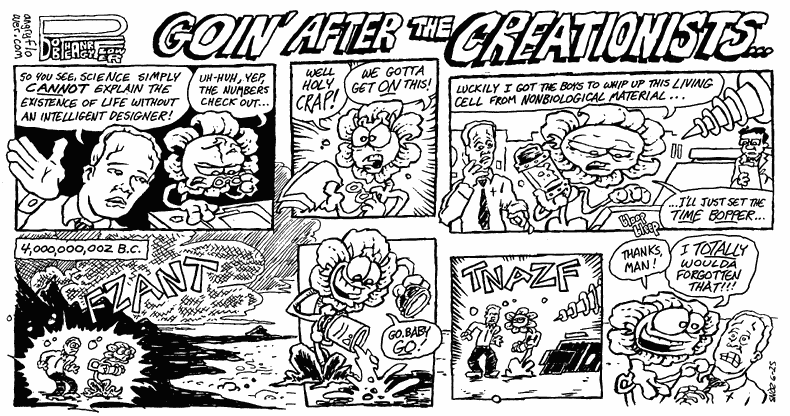
So as usual, getting to the point after a wild series of paragraphs of blah-blah-blah-blah... Where does life come from, if not from an intelligence that is not life, at least, not as we know it? A DVD without a DVD player is useless, and vice versa. DNA without life does nothing, and if you somehow could remove all the DNA from a living organism, it would cease to function in fairly short order, and certainly would never fulfill its primary evolutionary function, which is to reproduce itself. So it seems logical, to me at least, that there must exist (or once have existed) an intelligent being that is not an earthly life form. While that intelligent being may not be "God" in the sense we tend to think about it, I have a hard time thinking of any alternate ideas that don't approach ridiculousness. It is for this reason that I have been fairly confident that there is a divine Creator, even in the days before I was a Christian.

I'd love to hear anyone's thoughts on this.

Tuesday, August 15, 2006

Rising to the challenge, part I: My goose cooked?

Well, as I may have hinted in my last post, I have a number of subjects on deck, so to speak, and just haven't gotten around to polishing them up and posting them due to them being not up to my usual quality (insert self-deprecating blog humor here). In particular, let me foreshadow that I had a few things to say about the evolution vs. creation debate that I think will be thought-provoking, but maybe I'll break it down into several posts like I did with the separation of church and state posts (1 2 3 4).

At the moment, I am going to go back and revisit one of my previous posts that's one of my favorites, and has now become a much more popular one thanks to my sneaking a link into a much more popular blog. I think the post itself doesn't need much in the way of restatement, but various responses I have finally received lead to further discussion.

Francois Tremblay says something that I think cuts to the heart of the matter, partially because I asked for an opinion on whether the suggestion of God proving Himself or my responding challenge really has meaning. He says "it is quite impossible for us to know that any given event is non-natural" which I hope believers in the supernatural will see to be quite true! Hypothetically, if there was an event that was non-natural, how would we be able to tell? (I may take this in more detail as a future post soon.) He also points out that believing that God could exist implies living in a completely different mind frame than believing that God could not exist. What little significance the "atheist challenge" has, if any, depends largely on what sort of atheist a person is. A person who knows God does not exist will see it differently from a person who is of the opinion that God does not exist, who will in turn see it different from someone who simply doesn't know whether God exists or not.

On a side note to this last point, I've heard atheists make the clever comment that most people are atheists of some sort or another. I may believe in Jesus, but I am an atheist in respect to Zeus, get it? So one interesting restatement of the original question that will allow Christians and other theists to play along in this sort of philosophical train of thought is:

3: Give a hypothetical undeniable proof of the existence of the God of the Quran. (If you're a Muslim, you could still use the wording of challenge #2.) Essentially, suggest a way that "Allah" could send an unambiguous message to the world so that everyone could understand fully that our purpose in life should be to follow the teachings of the Prophet Muhammad. You may have a good answer, or you may see from this perspective why the original question is not so meaningful.

Bookjunky makes some suggestions that I think are very good, but I will save for my next post. Partly because I he reposted much of his comment in my blog, and I'll respond to those posted here separately, and partially because his response is in an odd fashion related to Zachary Moore's response, in which he points out that while surely there may be miraculous signs that would make you give consideration to God, you might still not "worship a being so immoral". This is oddly enough a more difficult hurdle for people who do not believe than lack of physical evidence. People don't believe because they don't want to, and they feel perfectly justified in denying a perceived cruel deity.

Zendo Deb refers to the ending of Carl Sagan's book "Contact", which he says was "expunged" of all religious references when made into a movie. Oddly enough, I found "" to be an incredibly spiritual movie myself, so I'm more eager than ever to read the book, which is high on my list of books to read sometime soon. His suggestion?

Obviously non-random information would have to be hidden in various computations. The digits of pi, when expanded to some large number of digits would be seen to contain certain messages, and so on for other non-rational real number representations.
I find this a fascinating suggestion, and one that I could devote a whole series of posts to. I may do at least one. My thought on this? In the movie "Contact", Jodie Foster's character hears some radio pulses coming from outer space and says, "Those are primes! 2,3,5,7, those are all prime numbers and there's no way that's a natural phenomenon!" If the pulses did come from a natural phenomenon, say a radio source that had a fifty/fifty chance of either pulsing or pausing, the chance of that particular sequence coming up is one in 1,048,576. That alone was enough to convince her that this was not natural, but on top of that, there was encoded within the signal the blueprints for a massive and complicated machine.

For me, the idea that we could discover a complicated code that gave instructions for the building of an elaborate machine that was not created by human intelligence would be evidence enough for me to assume a higher intelligence was out there and was interested in talking to us. Of course, as far as I'm concerned, that's a good description of DNA. Living things, down to the very cellular level are perplexingly intricate machines that are far beyond the ability of any human engineer to design. This message is obviously not unambiguous enough for everyone to believe there's something more than mere random effects of evolution walking about on our planet, but for me it tends to be enough to wonder. Is it enough for Zendo Deb or any other skeptic to at least consider agnosticism?