Showing posts with label PvP. Show all posts

Friday, April 13, 2007

If you're going to sin, you might as well be original

There's been a lot of buzz around the Internet about a piece of stolen artwork, and it's growing. Not just the buzz, but the scope of the theft.
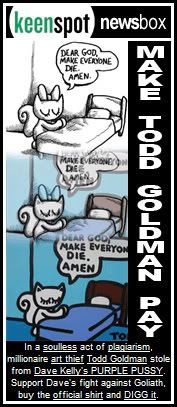
Todd Goldman, an "artist" and online purveyor of pop-art T-shirts was holding an art exhibit of his works and somebody noticed a similarity between the art on one of the canvases and a webcomic drawn by Dave "Shmorky" Kelly in 2001. Fans of Shmorky researched, and the plot thickened. Among several versions of the work in question, one of them appeared, upon being superimposed with the webcomic, to have actually been traced from it! This wasn't merely an homage, but surprisingly blatant plagiarism. That wasn't all; further research of Goldman's (so-called) work turned up case after case of striking similarities to extant works found in various places on the web. It's hard to say where any of this is leading, or how much of this is a misunderstanding, but it seems that virtually nothing that Goldman has created is original. It's a fascinating story, and if you're not familiar, you might want to read about it and see the evidence yourself.

I'm not here to condemn Goldman, nor do I intend to defend him. What I want to consider here is the nature of plagiarism.

When I was in college, I took a lot of courses from a lot of different disciplines. However, not being much of an artist (on the technical side, that is; I like to think I'm creative), I ended up taking only one course from the art department, a course known as "Photomechanical Reproduction". In other words, we were making art with Xerox machines. It's been a heck of long time now since I was in that class, but as hazy as my memory is, I do remember the issues that it brought up on the subject of what art really is, the nature of originality and the legal aspect of fair usage. (Although I tried a number of different techniques throughout the course, my favorite images to work off of were money; for one project I made a stack of very authentic-looking zero-dollar bills using only the money I had in my pocket and the free supplies at the local Kinko's.)

You could scoff at such work being considered "art"--and you could probably come up with some snide remark relating the idea back to Goldman's dubious techniques--but there was really something to it, and over the years since then, I've used the things I learned repeatedly to make what I considered to be works of art, sometimes from somebody else's art as a basis, and sometimes from nothing at all; you can make rather interesting art on a Xerox machine with no source material at all, if you know a few tricks. Maybe I ought to scan and post a few I've done. But as usual, I'm getting off-topic. The question is: is copying another person's art something that can be art itself?

Webcomics artist Scott Kurtz put one of his own characters in a pose just like the original piece, and had him say the same line, but nobody considers that plagiarism, I assume. It's not just because Kurtz didn't trace the artwork like Goldman did; there are a lot of works in Goldman's portfolio that people are calling rip-offs that don't really look much like the thing people are claiming he ripped off. At the same time, something can be a blatantly stolen and still be somehow special and original because it's intended for parody purposes. Think "Weird Al" Yankovic, or better, a little panel I threw together in a couple minutes:

It doesn't matter so much that both the image and the caption are blatant copies; I'm not likely to get sued for this picture because I'm making a point with it, not trying to rip off Shmorky or Jim Davis. In many ways, intent has a great deal to do with whether something is considered plagiarised, doesn't it? If I printed out the original webcomic and put it on the wall of my office, people would see it and laugh, and nobody would have a problem with it, least of all the artist, who might even be flattered. Blow it up on a big canvas, tell people it's my original idea, and put a $5,000 price tag on it, and now we have a problem. An artist ought to have the rewards of his or her art and in the former case, I would be increasing the acclaim of the art, while in the latter, I'm taking money that should be theirs.

But people do take other people's artistic ideas and make money off of them all the time. I'm not just talking about parodies, which have some amount of legal protection, but stealing images in order to make an artistic statement that launches from preconceived notions of existing iconic images and ideas. How many people have made artistic statements launching from Grant Wood's "American Gothic"? (Contrary to popular belief, the image depicts a father and daughter, not a married couple.) There's something to the concept of taking a pre-existing idea and running with it in a new direction, or even taking it as it is and merely presenting it in a new fashion. Some artists, such as famously Marcel Duchamp, take items that are not not art, and present them as art.

Is there really such a thing as an original idea? Many great artists make their art by copying things they see in the world around them, or illustrating a well-known story. Even those that tend towards the more abstract still use concepts that we all understand on some level, whether it be the ordered, clean colored blocks of Piet Mondrian or the chaotic splatterings of Jackson Pollock. One might wonder what a change it would bring to the legal status of Goldman's work if he openly admitted the complete lack of originality, and stated proudly that his artistic genre was plagiarism. Really, why not?

The odd fact is that plagiarism is a very strange concept, one of those ones that is hard to define, but you "know it when you see it". When you were required to write a paper in school, you were probably admonished by your teachers to use the encyclopedia, but not copy your info directly out of it, but rather summarize. When you summarize or paraphrase, you state in your own words and sentence structures the meaning of someone else's writing. Since the words and the sentence structures are yours, you do not use quotation marks, though, of course, you must acknowledge the author of the idea. If you use the original sentence pattern and substitute synonyms for key words or use the original words and change the sentence pattern, you are not paraphrasing but plagiarizing, even if the source is acknowledged because both methods use someone else's expression without quotation marks. I copied most of this paragraph directly from another website about plagiarism in an attempt to be ironic, but is it plagiarism when I acknowlege having done it, despite lack of quotation marks?

Sure, Goldman stole the image, but in a way, the true originality of Goldman's method was the blatant manner in which he stole it. I don't know if anyone would call that art, though.

Monday, July 24, 2006

San Diego Comic-Con 2006

So I'm back from a long weekend that included a trip to the . I was very pleased with my visit, not in a small part due to the fact that I wasn't expecting to see much there that I really was looking forward to. Granted, the SDCC is just so darn large that you certainly won't get bored, it's just that I didn't know of too many artists that I was looking for there that I hadn't already met.

Well, it turned out once I started browsing around that I found quite a few good ones. Rather than rank the artists in terms of who I was most excited to see and therefore possibly slight somebody, I'll just tell you who I did see that excited me, and share a bit of the excitement.

Shortly after arriving, I overheard a couple walking past me having a discussion about a book the woman had just bought. "His name is 'Shannon'?" the man asked, looking at the signature on the cover. I spun towards them.

"Is Shannon Wheeler here?!" I asked. They verified that that was exactly who they were speaking of, and pointed me towards a stall overbrimming with merchandise, and Wheeler himself, natch. I picked up a signed copy of TMCM #10 and came back later for a T-shirt.

I then headed off to see one of the only artists that I was interested in that I was certain would be there, . I used to read her stuff all the time years ago, but had mainly lost track of her. I was glad to see her on the list of artists, and to find that she's still doing work despite being not nearly as well-known as she ought to be. I bought a comic for a friend and got it signed, and then bought a copy of "Real Cat Toons", which, as the site promises, came with an original drawing on the back. (I don't know if she always draws something like that; it may be because I mentioned my cat having just died.) She was a lovely, friendly person to talk to, and had a lot of cool freebies, including a parody comic about Christian intolerance towards homosexuals. (I'm hoping to share that with a few friends of mine; I'm hoping you know who you are, are reading this, and will e-mail me to tell me whether you'd like me to e-mail, snail mail, whatever the thing to you, if indeed you'd like it. Gregory said she not only doesn't mind it being copied, but hopes it does get copied regularly.)

Then I wandered off to find a few webcomics people I like, including Tycho and Gabe of and and Scott Kurtz of . I brought a copy of the strip that I'd linked to some time ago, and told him that as a Christian, I'd really liked it. He chuckled and began not only to sign, but to make a sketch. (Read the comic first before continuing this story; if offended, skip to the next paragraph.) I leaned over to see what he was drawing and groaned, "I'm going to regret this, aren't I?" His wife(?) exclaimed, "Oh, don't do that!" and he giggled gleefully and said, "But that's what it would be, wouldn't it?" I supposed so, but I told him I wouldn't frame it and put it up at the office.

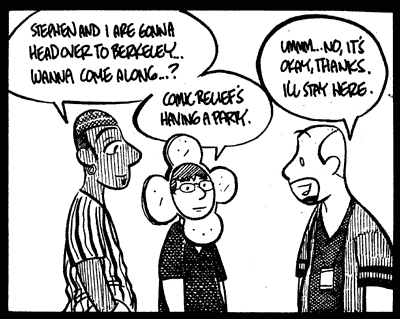
Later, I ran into the creator of , Stephen Notley. The guy actually wears a flower costume, and seems to have a brain that's just as random and genius as his comic. Really a neat guy to meet, he seems like the sort of guy you'd have a blast just sitting and talking to for a couple hours.

Lastly, (I don't think I forgot anyone, that would be embarrassing), I managed to meet Jeff Keane, the current artist (and son of the original artist) of , who was kind enough to knock out a quick sketch for me.

Perhaps at a later date, I'll post some photos I took, who knows?

Friday, May 19, 2006

The Da Vinci Code: a royal pain

Okay, this excellent comic has reminded me that once again this may be a time for me to make a topical post.

I know what thousands of people have been thinking in the midst of all the controversy. Yep. "What does Brucker think about this whole 'Da Vinci Code' thing?" Well, wonder no more, my fellow netizens! I am about to expound far beyond the limit of any reasonableness, that limit actually having passed probably two sentences ago. So long as I'm being pretty stupid already, let's have some fun and let me mock-interview myself as the leading authority on complete crap.

Running from Elevators: Well, let's get down to business. What did you think of the movie?

Brucker: I haven't seen it. I might eventually, but I'll probably wait for it to come out on video.

RfE: Well did you read the book, then?

B: Oh, I considered it, but I haven't had time for much reading lately. I've been spending what little time I have for reading books that freak out conservative Christians, like the Harry Potter books. Man, those are good. I've got some interesting thoughts on the ending of "[Harry Potter and the] Half-Blood Prince" that I'd love to share.

RFE: I don't think that's necessary. Surely, though, you have formed some sort of opinion on the book and movie just from hearsay, right?

B: Oh, yeah. Like probably 60% of the target audience, I know what the book is about; I even know the twist ending that probably not nearly so many people are aware of.

RFE: Yes, let's not spoil that, but let's talk about the main theme of the book. Do you think it's a dangerous one?

B: Well, yes and no. First of all, whatever danger there may be to Christianity, um, well, some of it may be overplayed. Like the joke in yesterday's PvP comic that you linked to above, there are some people in Christianity who don't want to believe Jesus was really much like a human at all. The concept that He definitely went to the bathroom, probably cried as an infant, may have had acne as a teenager, and so forth, is oddly offensive to some people.

RFE: Despite the fact that the Bible emphasizes His humanity.

B: Right. I mean, most people probably don't like to think of Jesus ever looking other than a tall, light-skinned, shiny-clean man in bright-white robes. But of course, He wasn't tall, probably had much darker skin than people of European ancestry, and the Bible even says that He took baths, so He must have gotten dirty. Probably, he got very dirty, seeing as He spent so much of His time wandering around from place to place on foot in an age where they didn't have concrete and asphalt pavement.

I would like to note as an aside that I've heard people complain about Jesus being portrayed by tall actors in films, and I don't think that's something that should be an issue. While Jesus almost certainly wasn't tall by modern standards, He may well have been tall for His own time and culture. If you're going to insist Jesus be played by someone short, you'd have to have a whole cast full of short people to match him.

RFE: So is the important issue of the "Code" the fact of Jesus' humanity?

B: Yes, but not entirely in the way one might think. I have heard that the premise is that Jesus was human, and the Church has been trying to cover up that fact by suppressing "Gnostic Gospels". The fact is, as far as I know, the Gnostics were far more inclined to deny the human aspect of Jesus' person than the mainstream church. Gnostics believed in mysticism and spirituality on a level where they didn't like the idea of Jesus being a flesh-and-blood individual. The Gnostics were also rather anti-feminist, which is also the reverse of how I understand they are portrayed in the story.

RFE: Which leads to the big point.

B: Yes, not the twist at the end, but the big secret that just about everyone knows--

RFE: Spoiler alert!

B: Right, heh. The big secret is that rather than the Apostle John being the most important figure in the early church movement, it was actually Mary Magdalene, who was Jesus' wife. Supposedly, while the Bible never says that Jesus married, the reason is not that He actually wasn't but rather that those details have been edited out and repeatedly suppressed by the Catholic Church, natch.

RFE: So the real meat of the story is there. What do you think about this idea?

B: Well, I have mixed feelings. As a "Bible-believing Christian" I would support the official stance of the mainstream churches that Jesus did not marry. On the other hand, as [PvP creator] Scott Kurtz says in his blog, "Good fiction makes you think. And thinking is never bad. There's nothing to be afraid of, even if you're a religious person. And what good is your faith if it can't stand up to being challenged from time to time? It's safe for Christians to read the book. It's just a story."

"The Da Vinci Code" is hardly the first or the only entity to speculate on the subject of Jesus being married. Some have pointed out that even in the Bible as we know it, edited or not, Jesus spends an awful lot of time with Mary for the both of them being single. It's something that's not really even socially acceptable in many modern societies. Also, the fact that they were both single at such an age in a culture where singleness was uncommon suggests to some that married or not, Mary was probably intended to be married to Jesus via an arranged marriage.

RFE: Is there any positive evidence in the Canonical Scriptures for such a marriage?

B: Eh, slight. Some have suggested the wedding feast at Cana was actually Jesus' wedding feast. Why was Jesus, as a mere guest, put in charge of the refreshments? Why do we never find out whose wedding it was? Why are Jesus' disciples there? If indeed this is Jesus' wedding, then the answer to all of these is fairly obvious.

RFE: But you still think Jesus was unmarried?

B: Yeah. And for a reason that may bother some conservative Christians almost as much as suggesting the possibility in the first place. Well, except Catholics. Church tradition. We sometimes tend to treat the idea of "tradition" as a bad word among evangelicals, as it conjures up images of men in robes and funny pointed hats chanting in Latin before a crowd of people genuflecting in unison. I don't think we really appreciate how much of our faith is built on tradition, though. Sure, the Bible is our foundation, but tradition is the framework of the house that was built on it.

RFE: But as an evangelical, you do reject much of that sort of tradition that you talk of amongst Catholics, right?

B: "Reject" is a strong word. I don't think it's necessarily a bad thing, but some people can get distracted by all the liturgy and miss the faith that should fill the inside of all that ritual. I reject it for myself, but wouldn't question the faith of someone who was in a more liturgical church just because they're that way. Most of those things come down to personal preference of worship style rather than a deep doctrinal issue.

RFE: So is Jesus' marital status a doctrinal issue?

B: Whew, that's a tough question. In some sense, everything about Jesus as a person is a doctrinal issue. When you deal with other people in the Bible, and their own personal lives, it's different. For instance, was Peter married? The Bible mentions him having a mother-in-law, but never talks about his wife. If Peter was the first Pope, and Popes are not to be married, this may be important on some level, but the marital status of the Pope is more like Church "policy" than doctrine. It may surprise some people to know that there are Catholic priests that are married. It has something to do with certain sub-sects of the Catholic Church which I don't fully understand.

But getting back to Jesus, the fine details of His life are far more prone to scrutiny. As I was essentially saying before, some people would hang precariously on the issue of whether Jesus ever picked His nose, but getting married is certainly something a bit more vital. I just don't know. It's potentially important, yes, but I don't personally see any reason it would bother me to suggest that Jesus was married, other than the fact that it's just not mentioned.

RFE: But what about the issue of children, and a royal bloodline?

B: See now, there is that, and one might wonder about the implications of a flesh and blood descendant of Jesus. The fact is, descendants of a person may not have much in common with that ancestor. If Jesus hypothetically did have a child or two, I don't see any reason they would be particularly special. In fact, if "The Da Vinci Code" is trying to simultaneously argue that Jesus was nobody special and yet that His descendant(s) are very special, well, I don't get it. Maybe I'll get it when I eventually get around to reading the book or watching the movie. There is no monarchy in Israel today, nor do I expect there ever will be one again, short of divine intervention, so being of the royal bloodline is, well, nothing. England is a country that still has a monarchy and they seem to just barely matter.

RFE: So you just don't see why we should care?

B: Exactly. The fact that there might be a living descendent of Jesus is about as interesting as knowing there might be a living descendant of George Washington. A bit of a curiosity, celebrity by association, but that's about all. My grandfather was very much into genealogy later in his life, and he discovered on tracing back his family tree that our family comes from French and English Royalty back in the 13th century. Interesting, but essentially meaningless in respects to who I am as a person.

RFE: So would you recommend going to see the movie?

B: I'd wait to hear what the reviews say and act accordingly. So far, I've heard a lot of bad press, and not much good. The general consensus on imdb.com so far is that it's pretty mediocre, and sometimes I go by that rather than reviews, but either way, it's not looking too promising.

Of course, there's the fact that somebody came up with a drive to have every Christian go and see "Over the Hedge" as a protest against "Da Vinci", which is an interesting idea. I'm wondering if it might work, especially with the movie being panned by critics. Oh, and it looks better-reviewed on imdb.

See whatever movie you want to see, I don't really care too much. Let me know what you think if you see either of those movies, I'm giving them both consideration.

RFE: We'll be sure to do that.

B: "We"? Can "we" stop typing yet?