Showing posts with label agnosticism. Show all posts

Sunday, March 16, 2014

About-Facebook

So I got "unfriended" today on Facebook. It was kind of an odd experience. I think what was particularly odd about it was that it was in the middle of a political discussion, and the person who unfriended me is someone that I find myself frequently in agreement with regarding political matters.

The place where we most certainly do not agree is in the area of religion. As I'm sure just about anyone knows, I'm a Christian. My former Facebook friend (FFF) is an agnostic, and a pretty hard-core one. Even though it was a political discussion going on with no perceptible religious undertones, my FFF took a moment to imply that my religion was a big part of the problem.

I'm having a hard time relating the story without simply copying and pasting the discussion here, but I think it's an important story nonetheless, because it largely defines the kind of person I am on a broader scale than just calling me a politically liberal Christian. See, my FFF implied that those people involved in the conversation that weren't liberals simply weren't worth the time having a political discussion with, and I disagreed. So he said he just had to unfriend me because he'd had enough of the "bullshit" that my religion was bringing on me.

I'm thinking that, given the context, he wasn't just talking about religion. Not really. After all, I'm even less of a preachy person outside of my blogging. I think the thing he had a problem with is the fact that so many of my Christian friends are (as Christians tend to be) very conservative. Yeah, he essentially said that he hates religion, but knowing him, (and I've known him IRL for over 20 years) I think the thing that really bothers him about Christianity is that so many Christians are conservative. If we all agreed with his political views and just happened to also believe in God, I'm sure he'd find Christians much more palatable. (Heck, he's put up with me just fine, so that's something, right?)

I know it's difficult to put up with people whose views you don't agree with, but this is where I know I also depart from his view, and this is the thing that, as I said, defines me as a person. I feel that shutting people out of my life because I disagree with them is just going to make the quality of my life (and maybe theirs) poorer. Just because I'm a Christian, I'm not going to forsake all my pagan, atheist, and agnostic friends. Just because I'm a Democrat doesn't mean I'm going to hate my Republican and Libertarian friends. Just because I love America doesn't mean I'm going to ignore anyone who lives outside of this country. I just believe that there's a fullness of life that you get from interacting with people whose viewpoints have the potential of broadening your own. If you only expend your time on people who have the same views as you, how will you ever learn anything new?

I guess I accept that my FFF may simply be dealing with anger issues (he also hinted at that) and just felt it was something he had to do for his sanity, but still, isn't there an easier way to deal with such things than cutting off your friends?

Thursday, October 02, 2008

Religulousness

Tuesday night, Bill Maher was on The Daily Show to promote his new documentary Religulous. Based on what I know of Maher, it's probably going to be a very entertaining movie, but it's probably, no make that definitely going to be extremely offensive to a lot of people. As is often customary for such talk show appearances, his visit was preceded by a showing of a clip from the movie.

In the clip, Maher pretends to be a crazy homeless person standing on a street corner, ranting about how all of us are possessed by the spirits of space aliens that were killed on earth billions of years ago by being dropped into a volcano by an evil being named Xenu. Some will of course recognize that he's really giving the foundational doctrines of Scientology, presented in a manner to make them seem extra silly. Shortly after the clip, Maher makes an interesting statement:

...[W]e laugh at this because that's the new religion, Scientology, but it's not really that weirder, more crazier than Christianity, I hate to tell you. We're just used to that one. But if someone came to you today and told you that story, you'd never heard that, and said, God had a son. He's a single parent. And He said to his son, "Jesus, I'm gonna send you to Earth on a suicide mission, but don't worry, they can't kill you because you're really me. But it is gonna hurt for a hot minute, I'm not gonna lie about that. You're gonna hate me, but it's the best thing for you, son--I mean me, it's best thing for me; I'm you, you're me! So here's the plan, son: I, God the Father, (wink-wink) I'll go down to Earth first! We'll split up the work, because we're two people! (Not really!) And I'll see if I can find a Palestinian woman to impregnate, so she can give birth to you--I mean me!" It's just the silliest thing you'd ever heard, and this is a monotheistic religion.
I'm not sure what monotheism has to do with it, but I think Maher is right nonetheless: When you really think about it, Christianity is sort of silly. Really. I mean, even the Bible says so, as a friend of mine pointed out when I asked his opinion on this. So score a point for Maher, I guess, but...a point for what?
Maher chose Christianity no doubt largely because it's the most popular religion in this country. To pick on Christianity is to be more controversial (as one potentially offends a greater portion of one's potential audience), and so often it's controversy that gets people in the theaters to watch a documentary. Actually, while I of course don't know whether it plays a role in the movie, the fact is that Maher made the statement that he doesn't think so highly of atheism either, since there's something nearly as presumptuous in claiming that one knows God does not exist as claiming to know he does exist. I'm guessing it's not in the movie, at least not much, since, despite the fact that a statement like that may be as offensive to the average atheist as the anecdote above would be to the average Christian, pointing it out doesn't tend to be quite as funny, and Maher's aim is as much to entertain as enlighten.
Scientology is easy. It really is a funny religion to just about everyone outside of it; you don't have to try so hard there. It's also a much smaller religion in terms of number of adherents. The fact is, however, that pretty much every religion has some ridiculousness to it (and I do get the impression that Maher tries to cover many different religions within the scope of the movie) and he could probably pick one out of a hat. Any one. So what's the point?
Seriously, I'm not sure where this is supposed to be going, at least so far as being informational, which one tends to expect of a documentary film to some degree. I'm finding myself once again in a position of more or less reviewing a film I have not actually seen; who knows how I end up here? I really do expect that the movie will be quite funny and entertaining, even the parts that should be offensive to me, but how is it going to enrich my life, or anyone else's?
Call me a strange theist, but isn't claiming that religion is ridiculous almost a tautology? Think about it. "Religion" is defined by Dictionary.com as "a set of beliefs concerning the cause, nature, and purpose of the universe, esp. when considered as the creation of a superhuman agency or agencies, usually involving devotional and ritual observances, and often containing a moral code governing the conduct of human affairs." Basically, when we talk of religion, we're talking about things that are outside the normal, natural, scientifically observable domain of physical reality, aren't we? We're talking about a higher power, be it personal or impersonal, singular or multiple, human-like or somehow beyond our understanding; isn't such a being or beings bound to be unusual by nature? (Or should one say "by supernature"?)
It's been said before that the Bible starts to get mind-blowing only four words into it. "In the beginning, God..." One pastor I heard teaching on Genesis paused here and said, "If you can accept that much, the rest of the book is easy." It tends to be the nature of religions, with very few exceptions, to believe that there exist powers of some sort that somehow predate the existence of the universe itself. It seems to me that even without such beings actually interacting with and influencing human history, just existing is remarkable. Is it silly for God to die on a cross? Maybe, but is it more or less silly for Him to become a human? Is it more or less silly for him to interact with humans at all? Or to have created humanity? To have even created a universe in which humans come to exist? To a Christian, none of these things are unthinkable, but to an atheist, every one is just as silly as any other, isn't it? "Hey, my atheist friend, I'll admit it: the whole Jesus Christ thing is just a fable. Still, you really should consider becoming a Jew. Or at least a Deist, maybe?" That wouldn't float.
Of course, at the same time, I just don't see that this kind of thing will have much of an impact on those of us who are of the religious bent. Surely Scientologists have heard it all, over and over again. As for Christians, does anyone think that there will be too many people who won't fit into one of two groups: the offended Christians who will turn away and not even watch, and the bemused Christians who will laugh in a lightly self-deprecating manner and go on believing exactly the same as before?
That's the thing of it: Maher is right, but so what? I can't help but see this film as coming across as a sort of anti-religious The Passion of the Christ, with controversial ridicule in the place of controversial violence. The people who are going to see this film for the most part are going to be those who already believe its likely conclusions, and didn't need a hundred minutes of footage to be convinced. It will be interesting to see how well it does at the box office, but I can't imagine it's going to change the world in the slightest. (Well, it got me the closest I'm ever likely to be to defending Scientology; I suppose that's something.)

Monday, October 02, 2006

Angels watching over my ass

About a week ago, I came across a sappy little . I'm not sure whether this is supposed to be cute or inspirational or what, but there it was in the paper, and thank goodness that Thel was attentive when that angel tapped her on the shoulder, or little PJ would have had a very bad day indeed. But you know, the whole thing bothered me, and it bothers me in the same way that hundreds of other stories like it bother me. I mean, even if you believe angels exist, isn't this sort of BS?

My mother, who is not a Christian, (at least in the more theologically conservative sense that I am: she's a Unitarian) had an incident in my own childhood that she attributes to the supernatural. See, one day she was making me macaroni and cheese, and I, a mere three-year-old at the time, thought I knew how this cooking thing was done, so I decided to get the noodles off of the stove myself, and in the process, poured about a gallon and a half of boiling water down my front. This is the sort of thing that would give most children a rather large scar for life, but my mother rushed into the kitchen, scooped me up, ripped off my clothes and dumped me in the bathtub under cold water. Having had no first-aid training, she confided to me many years later that the fact I am completely unmarked by that accident today is something she attributes to God. Surely, God somehow spoke to her and told her what to do. Do you see what might be lacking from this reasoning?

Well let me explain it with one more story that's truly my own, not my mother's. On a normal day in 1998, I was on my way to work. I was traveling south on a six-lane portion of Southern California freeway during rush hour at about 60 mph. There were four lanes to my left, and one lane to my right with a small concrete abutment separating it from an exit lane. In that lane to my right was a car being driven by a woman whom I somehow sensed was having trouble a second or two before anything happened; maybe I caught something in her facial expression out of the corner of my eye, I don't know.

In fifteen seconds, the following happened: Her car began to zigzag just slightly, and then spun out. One of the rear tires of her car made contact with the abutment and her car ricocheted off of it, and then her car was going straight, but at a 90-degree angle from the rest of rush hour traffic. The right front corner of her car plowed through the right rear corner of mine, and kept going across the freeway, leaving my car at a 45-degree angle to traffic, but still traveling in the same direction. As her car traveled across all lanes to my left, finally striking a pickup truck in the leftmost lane, my car resolved its contradictory momentum and position by flipping up and rolling end over end across the lane to my right, over the barrier and the exit lane, finally landing in a drainage ditch right side up. The pickup truck had landed on its roof, and the car that had started the whole thing came to a stop on the leftmost side of the southbound freeway. All three cars were demolished, but all three drivers were left without a scratch.

Later, someone commented to me upon hearing the story, "Wow, your guardian angel must have been working overtime that morning!" I responded with a polite nod, but was bewildered. It's not that I don't believe in angels. I believe in the Bible, and while it doesn't say much about angels, at does seem to be pretty clear that their existence is attested to in Scripture. It's not even that I don't believe in "guardian" angels. There's a bit of evidence for them in the Bible, and if angels exist at all, why not have them work as guardians? The problem is that if you suppose they exist and are going around tapping moms on the shoulder, delivering first aid advice and acting as divine airbags in serious auto crashes, you've got a lot of explaining to do.

Why would the Family Circus angel go tap Thel on the shoulder rather than just stop PJ, or even push the lamp out of the way? Why would my mother get a message on how to treat her son's burns rather than a message to go into the kitchen a few seconds earlier and stop me from doing something stupid? If angels can keep the accident that morning from effecting more than three cars, why not hold it to two cars, or one, or none? And what about all the children who do pull objects off of shelves onto themselves, be they lamps or pots of boiling water, and are injured and scarred for life? What of all those who are killed in auto accidents, whether they be believers in angels or avowed skeptics? I can't help but think that logically, it's all a bunch of hooey, you know?

Allow me to switch gears, though. I've been thinking about this subject off and on since I saw the cartoon, and that was over a week ago. I'd originally meant this as one of a series of posts talking about things that Christians generally believe that I find more than a bit dubious. I probably will still throw in a few things in future posts, but for some reason, I found myself rethinking this.

It's interesting to me that atheists do tend to point to religion as a practice of "blind faith". The truth is, there's not really any such thing. It's not like there are people who find a scrap of paper with the word "Jesus" on it and decide on the basis of that alone to become Christians. No, people have reasons, and one person's reason is different from another's. Some people were brought up in the culture of Christianity and never bothered to question it. Some people may have read the Bible and found it fulfilling something they thought they were lacking. A lot of people experience some sort of trauma in their life that makes them turn to spirituality to find meaning. I don't know anyone that became a Christian for no reason whatsoever.

It's that last point about traumatic experiences, though, that seems so suggestive. People who argue against God often bring up the bad things, the suffering, the hypocrisy, the disasters, etc., as a reason to disbelieve in God, but oddly enough, there are a lot of people who believe for those very reasons. A friend of mine who is a "pro-life" activist is not an activist because of her religious convictions, but developed religious convictions due to her activism. "When I saw the evil and violence that was at work in abortion, I was sure that nothing could be so evil unless there was something supernatural behind it. If there were supernatural forces at work in the world, then it made sense to me that God would be one of them." While her experience is quite different than most, I've met scores of people who decided to give their lives in service to Christ when they found they had reached rock bottom.

What is my point? Maybe it doesn't make much sense; it often doesn't to me. Still, could it not be possible that many instances of suffering are allowed by God and His angels for the purpose of a greater good? I remember years ago being at a Christian evangelistic rally at which two mishaps occurred in sequence. First, the P.A. system blew out, and those people who had gone forward to make a commitment to Christ were forced to crowd in closer to the stage in order to hear the pastor. Secondly, after the pastor was finished speaking, a technical problem occurred that would have easily killed someone who had been standing in the area many people were standing before the P.A. mishap forced them closer to the stage. Many in attendance chalked it up as a miracle that the P.A. system had gone out at such an opportune time, but I was skeptical; did two wrongs make a right? Why not have everything function properly with no mishaps at all? Perhaps for the person who had been standing on that spot, the malfunctioning P.A. system would somehow empower them to find greater faith than if they had just stood there with nothing happening.

In a perfect world where nothing ever went wrong, I doubt anyone would ever notice God.

Friday, September 15, 2006

Good grief!

I recently came across some material on another site trying to point out the old argument that there can't be a loving, omniscient, omnipotent God and suffering at the same time. It's an old argument that many far wiser heads than I will ever be have argued from either side, so I won't delve into the full argument, mostly to save space. (I dip into it in a later post anyway...)

The thing is, I remember discussing the topic a long time ago with an avowed agnostic. It was interesting to me at that time that the discussion turned to that topic, because at first, we had been discussing the idea of miracles. He referenced an argument from David Hume which I remember differently (and the given link seems to tell it the way I remember), but took his word for it. His version of the argument was as such:

A: A "miracle" is an event that defies the laws of nature.
B: An event that defies the laws of nature cannot be explained by science.
C: One cannot say with certainty that any event is impossible to be explained by science, only that with our current knowledge of scientific principles, we cannot understand it.
D: Therefore, rather than accepting an event as being a "miracle", it is more rational to assume it is simply something that future developments in science will explain to us.

Now, if you accept the definition of "miracle", which is reasonable enough for most people's purposes (although there's a bit more to "miracles" than that), then I think this argument, which was presented to me in less sloppy fashion than I have presented here, holds water pretty well. I admitted to the agnostic that he had a very good point, and as I think I have said in this blog as well, I don't doubt that science will one day explain everything, or at least has no limits to what it could potentially explain.

But the discussion went forward and evolved, as online discussions do, and it turned to what he presented as proof that God (as per the Bible, at least) does not exist. This argument was the argument from my first paragraph here. Now while his form of the argument was better than most I have heard, and he had managed to plug up most of the logical holes that exist in such arguments, I seem to recall two problems with his conclusions. One was very metaphysical, and I won't go into it here. The other was, to my delight, one that I presented in the same form as his previous argument. So many of these arguments for and against God are double-edged swords, and in the end, those who make them feel that they've closed the case, while at the same time, those on the other side remain utterly unconvinced. Oh well.

My argument? Well, the problem, as most people who argue for God to be able to coexist with suffering claim, is that it seems quite possible that good cannot exist without evil. Pleasure cannot exist without suffering. In order to make the world a truly wonderful place, God must allow some to suffer, and it may be beyond our comprehension why. A personal example from my own life was that I dated this woman for a while in college, but the relationship didn't go well. We broke up, and it was painful for both of us. Why should I have suffered that painful relationship and subsequent breakup? Well, I happen to know for a fact that if it were not for that failed relationship, and certain events that happened in the fallout from it, I would never have met the woman who became my wife. At the time I was suffering, I didn't know where it would lead, but it led somewhere good in the end.

That's a small example, but many Christians have heard of a more interesting one from the Holocaust. Corrie ten Boom, a Dutch woman whose family hid Jews in their house during the Nazi occupation, eventually ended up in a prison camp infested with fleas. She and her sister, who were in the same barracks, had smuggled in a Bible and were holding regular prayer meetings. Corrie was appalled on the night when her sister insisted that they should thank God for the fleas the barracks were infested with.

The fleas! This was too much. "Betsie, there's no way even God can make me grateful for a flea."

"Give thanks in all circumstances," she quoted [from 1Thess5]. "It doesn't say, 'in pleasant circumstances.' Fleas are part of this place where God has put us."

And so we stood between tiers of bunks and gave thanks for fleas. But this time I was sure Betsie was wrong.

Later, Betsie made an interesting discovery.

"You're looking extraordinarily pleased with yourself," I told her.

"You know, we've never understood why we had so much freedom in the big room," she said. "Well--I've found out."

That afternoon, she said, there'd been confusion in her knitting group about sock sizes and they'd asked the supervisor to come and settle it.

"But she wouldn't. She wouldn't step through the door and neither would the guards. And you know why?"

Betsie could not keep the triumph from her voice: "Because of the fleas! That's what she said, 'That place is crawling with fleas!' "

My mind rushed back to our first hour in this place. I remembered Betsie's bowed head, remembered her thanks to God for creatures I could see no use for.

And that's the sort of thing that I thought of when I was told that the world is too full of needless suffering. Just as he had faith in science being able to explain all, I had faith in God and His providence to explain all.

You cannot prove that any given instance of suffering has no point, you can only make the claim as an opinion. Therefore, there is no such thing as pointless suffering, only suffering that we do not yet understand the purpose of.

(Excerpts from Corrie ten Boom's The Hiding Place)

Monday, August 21, 2006

Rising to the Challenge, part III: Dog on, "Well, it's DNA!" and still, "Ew, no God."

I'm going to take a moment to go back to the comments of both Zondo Deb and Jono, and continue to expand on a concept I touched on in part I of this series of posts.

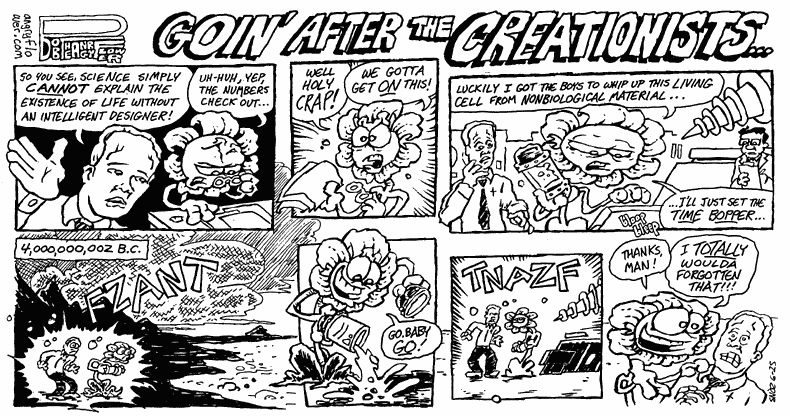
What if there was found in nature a message that unambiguously pointed to a higher power? Call me naive, but I still think there is. It's a message found inside every living thing on the planet, and it's called DNA. Now I admit I'm no biochemist, or whatever it is one might need to be to become an expert on DNA and all related sub-cellular information-carrying and processing molecules, but there is something fascinating going on at the microscopic level in living cells. Maybe it's the sort of thing that one would write off as creationist propaganda, but while I realize some creationists like to grasp at scientific and pseudoscientific straws, a lot of the things I plan to discuss here were things that I had mused over back in the days before I was a Christian, and I've never been a strict Biblical Fundamentalist Creationist. (Some of my views on creationism can be found at my other blog, mostly back about a year ago.)

What is DNA? It's a complicated molecule that carries within it a sort of chemical code. The code is written in four different chemical letters called "bases" which essentially come together to form various three-letter words that spell out sentences called "genes". Those words correspond to amino acids, which according to the gene they are in will be strung together to make a protein. Human DNA has about 3,000,000,000 bases which code for about 30,000 genes.

Now, admittedly human genetics are more complicated than those of lower forms of life, but you have to consider that the complexity goes down to a cellular level. Each individual cell of any living creature is made up of complicated little machineries which exist to process fluids, move minerals and burn fuel. The various genes coded onto DNA are accessed to formulize the creation of all the little proteins that make the parts that run the machinery of the cell.

Imagine trying to create a functioning automobile out of tinker toys. (Such a car would be huge, but scale isn't so important in imagining it, as the tinker toys at the cellular level aren't visible to the naked eye.) Just imagine fitting together tiny little pieces to make a machine that can transport things from one place to another under its own power, and has the standard amenities like power steering, anti-lock brakes, etc. That's an approach to the complexity that exists in a cell, but a cell is actually far more complicated than that. And aside from the complexity of the structures that make a cell simply function, there's also the fact that living cells have the property of self-replication. That is to say, imagine not only building a car out of tinker toys, but in the engine of your tinker toy car, you've got a sort of tinker toy encoded blueprint of the car that, rather than sitting there statically waiting for some tinker toy virtuoso to come along and read it to build another car, the car itself will gather loose tinker toy parts it finds and build more tinker toy cars as part of its normal function. Imagine building a car like that made from any material! And that's just a cell; imagine the further complexity of building a whole body!

Irreducible complexity is a popular concept among "Intelligent Design" proponents these days, but has some serious flaws scientifically, some of which I expect to address at a future date. The thing that really fascinates me, and something I've never heard addressed by any ID people, is a sub-cellular chicken-or-egg problem. (I actually heard this from an author who I believe is an atheist.) You've got DNA, right? It's a coded message that tells you how to build a human being, an amoeba, a redwood tree, whatever sort of massive "tinker toy car" it's a part of. How is the code read? Well, there are various sub-cellular structures such as RNA that serve various purposes like reading the code off, gathering the appropriate amino acids, stringing them together, checking the code for errors, making copies of DNA, and even cellular-level immune systems to protect from virus intrusion (these are totally separate from the system-level immune systems such as your white blood cells). All of these structures and systems are like the hardware on which the software of the DNA code is run.

Where does that hardware come from? Answer: it's built from certain parts of the code integrated into DNA. So you can't have the machineries that build living things on the cellular level unless you have the machinery to build them already in existence. Put raw DNA in a beaker and wait to see what happens. Nothing. Try with water, cold or hot. Nothing. Add a bunch of carbon, nitrogen and trace amounts of other important minerals. Still nothing. How about a warm soup of amino acids in varyingly oxygenated and heated environments? It will do nothing. Nothing whatsoever. No, DNA only functions in its natural environment, surrounded by a living cellular structure. And living cells don't come from nowhere.

So as usual, getting to the point after a wild series of paragraphs of blah-blah-blah-blah... Where does life come from, if not from an intelligence that is not life, at least, not as we know it? A DVD without a DVD player is useless, and vice versa. DNA without life does nothing, and if you somehow could remove all the DNA from a living organism, it would cease to function in fairly short order, and certainly would never fulfill its primary evolutionary function, which is to reproduce itself. So it seems logical, to me at least, that there must exist (or once have existed) an intelligent being that is not an earthly life form. While that intelligent being may not be "God" in the sense we tend to think about it, I have a hard time thinking of any alternate ideas that don't approach ridiculousness. It is for this reason that I have been fairly confident that there is a divine Creator, even in the days before I was a Christian.

I'd love to hear anyone's thoughts on this.

Friday, August 18, 2006

Rising to the Challenge, part II: A freakin' miracle!

Back from my short vacation (or maybe longer one from the Internet if I don't finish this until Monday) I resume my commentary on the responses to my "" inspired in part from my posting on Goosing the Antithesis.

I might as well address the response given by Sharon, who, although not an atheist, is very close friends with one who makes an interesting suggestion that God might simply alter our brain structure so that we become believers. Aside from the logical problems I have with that and address there, my desire is definitely to address the question with the understanding that free choice continues to be a part of the process. (On a side note, if free choice does not exist anyway, then the question is in many ways meaningless.)

Finally getting back to the response by bookjunky, he makes one of the best suggestions I have heard, I think. He suggests that if the earth's rotation were reversed without harm being caused to life on the planet, that would be a clear-cut miracle, as such a thing should simply not be possible. I think this is a good answer, as this indeed would be hard to explain, and pretty much impossible as a natural phenomenon, as he suggests. The following suggestion that God would need to give an explanation to everyone on earth is probably a necessary part, as the miracle itself would have no reference. Some people might find it hard to fully understand why, but Jesus coming back from the dead or raising someone else from the dead is more meaningful than someone coming back from the dead without some sort of prophet around. A miracle without context is interesting, but meaningless.

Other suggestions given are parting the Pacific Ocean, and moving of the stars to spell out a message in all languages (possibly a logical impossibility). This latter suggestion is also essentially given by Jono. All interesting responses, but I believe flawed at their heart for the real reason I think is at the center of this question. As bookjunky says:

Would I then believe in a Christian version of God? Hell, no.
Ouch. I think this is significant. Is it enough to simply believe that there is a higher power out there, or is it necessary, in God (be it the Christian God or not) wanting us to believe, that we believe properly? This seems to be a foundational truth of most religions, despite some people claiming the contary. It's not enough just to "be sincere in your belief". You have to be sincere in the belief of the right thing.

Hey, maybe there's a good reason somebody has to disbelieve in the God of the Bible. Then again, there are some people who feel that they have good reason to disbelieve that God exists at all in any form. That's part of what makes Francois' response so appealing to me. He doesn't simply say he has no answer, he positively asserts that the answer does not exist! Even though I happen to believe in God, I, too believe there is no answer to this question, specifically because of our will to deny whatever we will. It may be faith, it may be logic, it may be a number of things, but there are people out there who do believe, people out there who would be willing to believe (or think they would), and people who will not believe. I don't think God can please them all.

Tuesday, August 15, 2006

Rising to the challenge, part I: My goose cooked?

Well, as I may have hinted in my last post, I have a number of subjects on deck, so to speak, and just haven't gotten around to polishing them up and posting them due to them being not up to my usual quality (insert self-deprecating blog humor here). In particular, let me foreshadow that I had a few things to say about the evolution vs. creation debate that I think will be thought-provoking, but maybe I'll break it down into several posts like I did with the separation of church and state posts (1 2 3 4).

At the moment, I am going to go back and revisit one of my previous posts that's one of my favorites, and has now become a much more popular one thanks to my sneaking a link into a much more popular blog. I think the post itself doesn't need much in the way of restatement, but various responses I have finally received lead to further discussion.

Francois Tremblay says something that I think cuts to the heart of the matter, partially because I asked for an opinion on whether the suggestion of God proving Himself or my responding challenge really has meaning. He says "it is quite impossible for us to know that any given event is non-natural" which I hope believers in the supernatural will see to be quite true! Hypothetically, if there was an event that was non-natural, how would we be able to tell? (I may take this in more detail as a future post soon.) He also points out that believing that God could exist implies living in a completely different mind frame than believing that God could not exist. What little significance the "atheist challenge" has, if any, depends largely on what sort of atheist a person is. A person who knows God does not exist will see it differently from a person who is of the opinion that God does not exist, who will in turn see it different from someone who simply doesn't know whether God exists or not.

On a side note to this last point, I've heard atheists make the clever comment that most people are atheists of some sort or another. I may believe in Jesus, but I am an atheist in respect to Zeus, get it? So one interesting restatement of the original question that will allow Christians and other theists to play along in this sort of philosophical train of thought is:

3: Give a hypothetical undeniable proof of the existence of the God of the Quran. (If you're a Muslim, you could still use the wording of challenge #2.) Essentially, suggest a way that "Allah" could send an unambiguous message to the world so that everyone could understand fully that our purpose in life should be to follow the teachings of the Prophet Muhammad. You may have a good answer, or you may see from this perspective why the original question is not so meaningful.

Bookjunky makes some suggestions that I think are very good, but I will save for my next post. Partly because I he reposted much of his comment in my blog, and I'll respond to those posted here separately, and partially because his response is in an odd fashion related to Zachary Moore's response, in which he points out that while surely there may be miraculous signs that would make you give consideration to God, you might still not "worship a being so immoral". This is oddly enough a more difficult hurdle for people who do not believe than lack of physical evidence. People don't believe because they don't want to, and they feel perfectly justified in denying a perceived cruel deity.

Zendo Deb refers to the ending of Carl Sagan's book "Contact", which he says was "expunged" of all religious references when made into a movie. Oddly enough, I found "" to be an incredibly spiritual movie myself, so I'm more eager than ever to read the book, which is high on my list of books to read sometime soon. His suggestion?

Obviously non-random information would have to be hidden in various computations. The digits of pi, when expanded to some large number of digits would be seen to contain certain messages, and so on for other non-rational real number representations.
I find this a fascinating suggestion, and one that I could devote a whole series of posts to. I may do at least one. My thought on this? In the movie "Contact", Jodie Foster's character hears some radio pulses coming from outer space and says, "Those are primes! 2,3,5,7, those are all prime numbers and there's no way that's a natural phenomenon!" If the pulses did come from a natural phenomenon, say a radio source that had a fifty/fifty chance of either pulsing or pausing, the chance of that particular sequence coming up is one in 1,048,576. That alone was enough to convince her that this was not natural, but on top of that, there was encoded within the signal the blueprints for a massive and complicated machine.

For me, the idea that we could discover a complicated code that gave instructions for the building of an elaborate machine that was not created by human intelligence would be evidence enough for me to assume a higher intelligence was out there and was interested in talking to us. Of course, as far as I'm concerned, that's a good description of DNA. Living things, down to the very cellular level are perplexingly intricate machines that are far beyond the ability of any human engineer to design. This message is obviously not unambiguous enough for everyone to believe there's something more than mere random effects of evolution walking about on our planet, but for me it tends to be enough to wonder. Is it enough for Zendo Deb or any other skeptic to at least consider agnosticism?

Wednesday, May 24, 2006

"...actual proof of God..."

From the comments section of my latest post in the ASAB:

Also, wouldn't you think that if God REALLY wanted everyone to believe in him the proof would be undeniable instead of nonexistant? Afterall, if there really was actual proof of God all of these "debates" would vanish.
The poster may have thought s/he was being original, or not. It doesn't matter. I've heard this many times before. It puzzles me to no end.

I ask you all here, and the poster as well: What exactly would be "undeniable" proof? I'm strongly preferring answers from atheists and other skeptics here.

Technorati tags:

Thursday, December 01, 2005

Membership hath its privileges

There's an interesting facet of Christianity that I find sometimes hard to swallow on an intellectual level, despite the fact that I take it on faith. People that are not Christians, mostly agnostics and atheists, complain that it's unfair for Christianity to make the claim that it has exclusive access to Truth-with-a-capital-T. If Jesus is going to say "I am the way and the truth and the life. No one comes to the Father except through me." (John 14:6) then isn't he being rather intolerant? Well aside from the fact that I don't think that this technically fits the actual definition of intolerant, and that Jesus, being God, pretty much has the right to set the rules however He wants, the thing I think this objection misses very often is the fact that Christianity is not the only religion by far that makes claims of exclusivity. Lots and lots of religions claim to be the only "true" religion, and really, it's a whole topic in itself as to why I think that's not only acceptable, but desirable in a religious practice. But this topic of exclusivity is not the "facet" that I really wanted to talk about, although it's somewhat related, I suppose.

The thing about Christianity that I was pondering yesterday evening was part of the whole, "Don't say you'll believe it when you see it, but believe and then you'll see!" phenomenon. While I believe that there is a great deal of Christianity and its doctrines that can be intellectually understood without having to be a Christian, I think all (well, perhaps most) Christians realize that there is an element of faith that only true believers have a grasp on. We evangelicals have what we like to call "a personal relationship with God." What is that, exactly? I don't think I can describe it to someone who hasn't experienced it for themself, which is too bad, since it's what's really at the heart of Christianity when you strip everything else away.

Interestingly enough, and one of the reasons it's related to the topic in the first paragraph, I found myself pondering this in the midst of reading about Zen Buddhism. I realized that exclusivity is not the only thing by far about Christianity that's hard for an outsider to accept, yet is common to many religions. What is at the center of Zen Buddhism? The experience of zen. What is zen? Well, although philosophers of various religious beliefs can talk about it at length and discuss things about zen, zen itself is not something that can be put into words, even by those who have experienced it. In fact, the inability to describe zen is an inherent property of it, the word "zen" meaning essentially "wordlessness".

Such a concept is found in the Bible in a number of ways. Paul wrote about a vision in which "He heard inexpressible things, things that man is not permitted to tell." (2Cor. 12:4) But aside from that special incident, he writes more generally and practically that "The man without the Spirit does not accept the things that come from the Spirit of God, for they are foolishness to him, and he cannot understand them, because they are spiritually discerned." (1Cor. 2:14) There is a concept in many religions that there is just a certain level of spiritual enlightenment that only the true believers will ever experience.

Interestingly enough, I'd say that it's a belief that even some atheists harbor in an odd way. I've been told by atheists that if only I would cease to believe in God for a moment, I'd see how ridiculous the Bible and Christianity as a whole are. Perhaps they're right, but if so, aren't they essentially suggesting that there is such a thing as special atheistic enlightenment that only true atheists can experience? What a concept! (It's hardly a common view among atheists in general, though. If atheists were a religious classification as Christianity is, there would probably be as many "sects" of atheism as there are atheists.)

I'm wondering if the only point of this blog is to toss out thoughts on unanswerable questions that I'm not really asking, nor looking for feedback on. I'm not sure what my point is here in general, and it sounds like yesterday's post, with a lot of "well maybe, or maybe not". Are these facets of Christianity logically unacceptable? Yet they're used by so many. I remember the irony of once having a discussion on the value of various "ex-gay" ministries. There was a lesbian who claimed that if any of these sorts of ministries ever had any successes, it wasn't that they were turning homosexuals into non-homosexuals, but that they were turning bisexuals into operative heterosexuals. How could she be so sure? Because if they were able to be attracted to women ever, then they were simply not homosexuals, nor had they ever been. I thought this was a very familiar concept, and realized it was from 1John 2:19: "They went out from us, but they did not really belong to us. For if they had belonged to us, they would have remained with us; but their going showed that none of them belonged to us." See, there's no such thing as an ex-Christian; if a person leaves Christianity, it means they were never really a part of it in the first place.

Christianity has its particulars that are strange and hard to understand, but they don't set it apart as particularly wrong so much as just one among many belief systems. Sure, Christianity is special, but not for any of the above reasons.