Showing posts with label creativity. Show all posts

Friday, March 28, 2008

Paperless office of the mind

I was thinking last night about blogging. I was thinking about what it is that appeals to me. Thank heaven that it's not the publicity, because among the few hits I do get on this blog, the majority of them still seem to be looking for penguin sex.

See, I've always done this, even before the world wide web existed. I used to journal. You know, I'd get one of those little books with blank pages, and write whatever was on my mind in it whenever the mood took me. It even had some limited amount of readership, as I would always encourage friends who visited me to feel free to pick up a journal and peruse it. (I girl I was dating once read one cover-to-cover, which led to a few interesting conversations.) Someone once told me that largely what computer technology does is not so much make new things, but make electronic versions of things that already existed. Blogs are really electronic diaries.

But there's a difference that for me is key. I think what started me thinking about this last night was hearing someone say something like, "There's nothing scary about an empty piece of paper." I have no recollection of where I heard it or if that was anything like an exact quote. But I remembered that back in my journaling days, there was indeed something quite scary to me about a blank piece of paper.

I actually even once wrote a journal entry about it, and while I don't have it with me now, I remember it pretty well. I'd bought a new journal, and I began to write about an intense fear I had at the very moment the pen touched the paper. Here was a whole book full of empty pages, and while I tended to think those journals were overpriced, the actual value of the thing was as yet to be determined. An empty book held infinite promise, like a block of marble, waiting for the artist's chisel. It could be a book of recipes, a novel, a scientific thesis, a portfolio of sketches, an autobiography, anything was possible. However, once the pen met the paper and the writing began, all those infinite possibilities would disappear, and the result, no matter how great it might possibly be, could never possibly live up to the infinite promise of the empty page.

Of course, there's nothing rational about it. An empty page is, in a more tangible sense, nothing at all. To say that an empty page is somehow better would of course make no sense, the promise of anything without actualization is the delivery of nothing at all. Yet it stuck with me, every time I went to write.

There also was the fact that I felt since the page was a certain size, my writing had to fill it. It always surprised me how many times I ended up writing a snippet of fiction or a personal reflection that was worded so that it would just exactly fit the page size allotted. I was a slave to the physical medium of my writing.

And THAT'S what makes blogging so great. The medium of the web is pure information. There is no paper sitting there before me with the promise of anything. When I start a new blog entry, there is no space to fill: you can't scroll down the page to see the blank space below, as there is a presentation of nothing but a cursor, blinking and waiting. There's no permanence of the medium, and if I'm not happy with my writing, There's no ripping out of pages, crumpling them up and throwing them in the waste basket, there's just the click of a button, and all is gone! Or better yet, I simply can decide not to press the "Publish post" button.

There's no pressure to create greatness when nothing is being wasted but time. The internet is pure information. Our writing need not be stacks of dusty forgotten journals, our music need not be piles of CDs in cracked jewel cases, our photos are not limited by the quantity of film we can afford to buy. Hey, how many times have you seen this?

Lorem ipsum dolor sit amet, consectetur adipisicing elit, sed do eiusmod tempor incididunt ut labore et dolore magna aliqua. Ut enim ad minim veniam, quis nostrud exercitation ullamco laboris nisi ut aliquip ex ea commodo consequat. Duis aute irure dolor in reprehenderit in voluptate velit esse cillum dolore eu fugiat nulla pariatur. Excepteur sint occaecat cupidatat non proident, sunt in culpa qui officia deserunt mollit anim id est laborum.
Who would bother to write that out longhand? But in an electronic medium, we toss out a page of gibberish just to fill imaginary space. Here; I'll do it again, just because I can:
Lorem ipsum dolor sit amet, consectetur adipisicing elit, sed do eiusmod tempor incididunt ut labore et dolore magna aliqua. Ut enim ad minim veniam, quis nostrud exercitation ullamco laboris nisi ut aliquip ex ea commodo consequat. Duis aute irure dolor in reprehenderit in voluptate velit esse cillum dolore eu fugiat nulla pariatur. Excepteur sint occaecat cupidatat non proident, sunt in culpa qui officia deserunt mollit anim id est laborum.
There's something oddly freeing about that.

And what's my point? (Does it matter if I have one?) This blog is a journal in a sense, yes, but it is a journal that shares very little in the way of the physical properties of a "journal" as was known in the classic sense. Just as Scott McCloud wrote years ago about the idea of comics on an "infinite canvas", so all electronic forms of media have no limits in the digital world. Isn't a blog a journal with an infinite number of pages? Isn't a live webcam a documentary film of infinite length? Isn't 3D modeling sculpture with an infinite-sized lump of clay? The web allows media within it to be everything or nothing, all at once. It's exciting, but perhaps most of all, it's fun.

Friday, April 13, 2007

If you're going to sin, you might as well be original

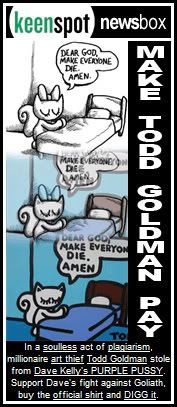
There's been a lot of buzz around the Internet about a piece of stolen artwork, and it's growing. Not just the buzz, but the scope of the theft.

Todd Goldman, an "artist" and online purveyor of pop-art T-shirts was holding an art exhibit of his works and somebody noticed a similarity between the art on one of the canvases and a webcomic drawn by Dave "Shmorky" Kelly in 2001. Fans of Shmorky researched, and the plot thickened. Among several versions of the work in question, one of them appeared, upon being superimposed with the webcomic, to have actually been traced from it! This wasn't merely an homage, but surprisingly blatant plagiarism. That wasn't all; further research of Goldman's (so-called) work turned up case after case of striking similarities to extant works found in various places on the web. It's hard to say where any of this is leading, or how much of this is a misunderstanding, but it seems that virtually nothing that Goldman has created is original. It's a fascinating story, and if you're not familiar, you might want to read about it and see the evidence yourself.

I'm not here to condemn Goldman, nor do I intend to defend him. What I want to consider here is the nature of plagiarism.

When I was in college, I took a lot of courses from a lot of different disciplines. However, not being much of an artist (on the technical side, that is; I like to think I'm creative), I ended up taking only one course from the art department, a course known as "Photomechanical Reproduction". In other words, we were making art with Xerox machines. It's been a heck of long time now since I was in that class, but as hazy as my memory is, I do remember the issues that it brought up on the subject of what art really is, the nature of originality and the legal aspect of fair usage. (Although I tried a number of different techniques throughout the course, my favorite images to work off of were money; for one project I made a stack of very authentic-looking zero-dollar bills using only the money I had in my pocket and the free supplies at the local Kinko's.)

You could scoff at such work being considered "art"--and you could probably come up with some snide remark relating the idea back to Goldman's dubious techniques--but there was really something to it, and over the years since then, I've used the things I learned repeatedly to make what I considered to be works of art, sometimes from somebody else's art as a basis, and sometimes from nothing at all; you can make rather interesting art on a Xerox machine with no source material at all, if you know a few tricks. Maybe I ought to scan and post a few I've done. But as usual, I'm getting off-topic. The question is: is copying another person's art something that can be art itself?

Webcomics artist Scott Kurtz put one of his own characters in a pose just like the original piece, and had him say the same line, but nobody considers that plagiarism, I assume. It's not just because Kurtz didn't trace the artwork like Goldman did; there are a lot of works in Goldman's portfolio that people are calling rip-offs that don't really look much like the thing people are claiming he ripped off. At the same time, something can be a blatantly stolen and still be somehow special and original because it's intended for parody purposes. Think "Weird Al" Yankovic, or better, a little panel I threw together in a couple minutes:

It doesn't matter so much that both the image and the caption are blatant copies; I'm not likely to get sued for this picture because I'm making a point with it, not trying to rip off Shmorky or Jim Davis. In many ways, intent has a great deal to do with whether something is considered plagiarised, doesn't it? If I printed out the original webcomic and put it on the wall of my office, people would see it and laugh, and nobody would have a problem with it, least of all the artist, who might even be flattered. Blow it up on a big canvas, tell people it's my original idea, and put a $5,000 price tag on it, and now we have a problem. An artist ought to have the rewards of his or her art and in the former case, I would be increasing the acclaim of the art, while in the latter, I'm taking money that should be theirs.

But people do take other people's artistic ideas and make money off of them all the time. I'm not just talking about parodies, which have some amount of legal protection, but stealing images in order to make an artistic statement that launches from preconceived notions of existing iconic images and ideas. How many people have made artistic statements launching from Grant Wood's "American Gothic"? (Contrary to popular belief, the image depicts a father and daughter, not a married couple.) There's something to the concept of taking a pre-existing idea and running with it in a new direction, or even taking it as it is and merely presenting it in a new fashion. Some artists, such as famously Marcel Duchamp, take items that are not not art, and present them as art.

Is there really such a thing as an original idea? Many great artists make their art by copying things they see in the world around them, or illustrating a well-known story. Even those that tend towards the more abstract still use concepts that we all understand on some level, whether it be the ordered, clean colored blocks of Piet Mondrian or the chaotic splatterings of Jackson Pollock. One might wonder what a change it would bring to the legal status of Goldman's work if he openly admitted the complete lack of originality, and stated proudly that his artistic genre was plagiarism. Really, why not?

The odd fact is that plagiarism is a very strange concept, one of those ones that is hard to define, but you "know it when you see it". When you were required to write a paper in school, you were probably admonished by your teachers to use the encyclopedia, but not copy your info directly out of it, but rather summarize. When you summarize or paraphrase, you state in your own words and sentence structures the meaning of someone else's writing. Since the words and the sentence structures are yours, you do not use quotation marks, though, of course, you must acknowledge the author of the idea. If you use the original sentence pattern and substitute synonyms for key words or use the original words and change the sentence pattern, you are not paraphrasing but plagiarizing, even if the source is acknowledged because both methods use someone else's expression without quotation marks. I copied most of this paragraph directly from another website about plagiarism in an attempt to be ironic, but is it plagiarism when I acknowlege having done it, despite lack of quotation marks?

Sure, Goldman stole the image, but in a way, the true originality of Goldman's method was the blatant manner in which he stole it. I don't know if anyone would call that art, though.