Thursday, August 10, 2006

Awakening the sleeping dad

After complaining about my own lack of consistent posting in my other blog, I've now gone over a week without posting at either of my blogs. It's not like I have a big enough audience of regular readers that I really need to explain myself, but I guess I personally feel the need. Plus, it gives me a chance to vent and complain, which we all really enjoy don't we? Or is it just me? (I noticed a few years back that I am actually entertained by the rants of people who seem to complain all the time. Whether it's an unexplainable personality quirk of mine or whether hearing other people's complaints makes me feel better about my own life, I don't know. I've always said that that's why I enjoy listening to The Smiths, who, for those of you not familiar, here's the lyrics of one of their biggest hits. I pop in an old tape, and the more pathetic Morrissey gets, the more cheerful I get. Go figure.)

Anyway, the thing that's getting me down is just life in general. As I'm sure I must have mentioned, I'm working two jobs right now, and it's wearing me out. I like a good solid eight hours of sleep, but tend to get four most nights these days. It's not fun making just enough money to get by while you don't get sufficient sleep or time together with your family. The way it's affecting my blogs is that I don't seem to have the mental energy to think coherently enough to write in a manner that feels proper to me. I actually have several unfinished posts stored up in this blog, and one in the other, but when I go to write on them, it doesn't sound right. For now, writing a little post of personal complaint, I feel more accepting of sloppiness, but the post I was working on this Monday seemed like an important one, and pretty much every post on my other blog is one I consider important. (And anyway, Exodus 21 is a really tough chapter to comment on!) The random gibberish that I type in a half-sleeping haze just doesn't seem sufficient for some topics.

Perhaps the worst of it for me personally was Tuesday. Blogs aside, which in the grand scheme of things are of course nothing, I got up before the sun, and came home after dark, never seeing my family at all. That sucks. I remember the one thing I worried about when I got a second job was that I'd turn out to be like my father.

Time for personal disclosure here. When I was two, my parents divorced, and so I really have virtually no memories of my parents together. (I do have a few, which surprises me, as I don't know that many people remember being two years old.) Most of my early childhood was spent with my mom, with something like twice-yearly visits to my dad's house. My dad at that time worked as a nurse, pulling the graveyard shift at the hospital. He always told me that doing graveyard was a great opportunity, because he was able to pull down lots of hours, since nobody wanted the shifts. However, on those twice yearly visits, he didn't often take time from work, and I would sit and watch television while he slept off the night shift. I wanted desperately to spend time with my dad, and grew to dispise his work and his dedication to it. Oddly enough, as an adult, I get a feeling of comfort rather than unease that most others feel when visiting the hospital; somehow I associate it with something warm and parental.

When I was discussing with my wife whether or not to get a second job, it was something I mentioned to her: the fact that my dad was someone who, from my point of view, seemed to sleep through my childhood. I didn't want to be that for my children. I wanted to be someone who would hear "Yay! Daddy's home!" rather than "Shhh! Daddy's home." and have my children wonder who I was beyond a snoring lump in the master bedroom.

The thing is, this is the sort of thing that I hope people only do because they have to, while I suspect my father did it because somewhere inside, he valued money more than relationships. This is the part where I start to feel sad about other people's problems rather than enjoying hearing complaints, because the people with the real problems in life hardly ever seem to be the ones complaining; they're too busy working to dig themselves out of their problems. I can complain, but in the end, this is only a temporary thing. My wife will be going back to work soon part time, as my childen are now old enough to start preschool. I'll drop my second job, and get some training to start a new career that will bring me more income. I've got a Bachelor's degree, and am looking to get a Master's in the future, and I have a lot of opportunity for upward mobility, even though my present situation is far from ideal. I'm not looking to own a big house and a fancy sports car, only to live my life with my family with some savings in the bank for emergencies and knowing that I will be able to send my children to college some day if they choose to go there (which I hope they will). I really think that I'll get there some day, maybe even within the next year or so. I also realize that there are many, many people who are not only not there, but will never get there.

There are people out there with families to support that they have to work two full-time jobs at minimum wage in order to do so, and their children must hardly know them. They sacrifice having the sort of personal relationship that (I hope) we all want to have with our children, not for a brighter future, but so that they don't starve. Sometimes it seems like one of the biggest injustices in life: that there are people who are trying hard to make life and families work, and are contributing to society in an irreplaceable manner no doubt, but never quite make things work out for themselves. Call me an anti-capitalist, but I have a hard time stomaching people who make millions of dollars who are doing it only for the purpose of making tons of money while there are others making next to nothing who only want to feed their children and put a roof over their heads.

So, depressed over my blog, depressed over my own problems, depressed over other people's problems, and even depressed over other people's successes, I take a moment out to complain. I hope I have entertained.

Wednesday, August 02, 2006

What is the soul?

There is a question that has plagued people for all of history, in one form or another: What is the soul? I thought I'd take some time to muse on the topic, not that I necessarily have some great insight into the matter, but simply that it was on my mind this morning for some unknown reason.

Firstly, I'd like to lift from a comment I left in Hellbound Alleee's blog (italics are H.A.'s words) :

Brucker, what reason to you have for believing that there is an essence of who we are?
I think Descartes' "Cogito ergo sum" is rather convincing. I don't know that the sorts of conclusions Descartes inferred from this position follow so logically as he might hope, but the central concept is there.

I feel that I can know that I exist, despite the fact that I can perform no experiment to tell me if my true essence is the sum parts of my body, just the brain, a disembodied spirit, or the hallucination of Hindu's Brahman. From a radically skeptical perspective I can doubt just about anything other than the basic fact that I exist as a conscious entity.

How about this: we have a body that perceives, metabolizes, feels emotion, and has a memory?

Who is this "we" that owns this body? Do you "have" a body, or are you a body? Choose your words carefully when talking about consciousness and self-identity.

There is no reason to believe in an "essence," a "soul," a "spook," a "homunculous," or a "self." If there is a reason, you should be able to point to something other than a body.

Is there reason to believe in your blog? I read some words on my computer screen, but is your blog on my computer? If so, does it cease to exist when I turn my computer off? Perhaps it's on a web server somewhere? If you took me to this server, would see your blog, or would I just see some boxes sitting in a room humming softly to themselves as electrical impulses passed through them?

The world has room enough for things that are not located spatially such that one can "point" to them, without having to even consider the spiritual realm. Indeed, where is the Internet? If you can't point to it, does that mean it doesn't exist?

There isn't a little man inside feeling and seeing. We already have everything we need in our bodies to do those things.

I agree. I would in no way advocate the concept that the soul is some sort of smaller self contained within the larger self. The soul is frankly something that I cannot define, but suspect resides in the physical body in much the way software resides on one's computer.
Since the discussion came to an end after my comment (I doubt I "stumped" her, she probably got bored and moved on.), I figured I might as well continue it here, since there are concepts I think are worth mulling over.

As I said, there are some things that Alleee said that I agree with. Our physical bodies are in no way lacking anything needed in order to function. (Well, one might argue that there is that mysterious "spark" of life that makes us alive, and is the difference between a live body and a dead one.) Despite what some philosophers have said about the soul being attached to the body via the pineal gland, it seems to me that if the soul is an entirely discorporate entity, a specific spot for the soul to attach itself to the physical body seems like a strange concept. Indeed, in Hindu philosophy, the purusha (soul?) is in no way connected to the prakriti (body?), and as such, when studying that religion, it was hard for me to understand the relationship between them, if indeed there was one at all.

As I said, I think there may be a possibility that what we term the "soul" may in fact be as much a part of the physical world as the "mind" is, or the "sense of self". That is to say, they exist, and in some way are localized within the brain, but rather than being a specific tangible object are instead an abstract concept that is an outgrowth of the function of that organ. (If I haven't made this clear, I'm not claiming it to be the case, only speculating it as a possibility that has merit to me.) I think the Internet comparison is a good starting point. The computer that I am now using has internal memory and a hard drive. To some extent, both of these are currently storing information about the program "Internet Explorer 6.0" which I often use to access this web site and create posts. Is IE6 a real thing? Most computer users with a good amount of knowledge know exactly what IE6 is when I refer to it, which suggests it is a real thing. Yet it has no mass, nor does it (as a concept) occupy physical space. Before my computer was set up with all of its software, the hard drive and the memory chips started out empty of information. After the software was installed, these components of my computer had the exact same gross physical characteristics they did before the installation. No mass was added, the shape did not change, and everything stayed in pretty much the same location until it was time to ship it off somewhere to eventually end up under my desk. If I wiped the memory clean, then like a dead body without a soul, it would still be there, looking exactly the same, but no longer functioning.

It's weird to me, but 100 posts into my other blog, after writing thoughts for a year (and more elsewhere) and creating page after page of information, I really have "created" nothing. Electrons have shuffled around, disks have spun, photons have fired out from monitors, but indeed, nothing was created. Go back to those hundred posts and replace every character with a "space", and in the purely physical sense of "you should be able to point to something", all would be the same as it was before.

Years back, I had a computer that had some serious problems, and ceased to function. When this happens, you've got a hunk of largely useless plastic and silicon. I got a new computer, a bigger (memory-wise), faster, and generally better one; and what did I do with the old computer? I opened it up, removed its hard drive, and hooked it up to the new computer. I cleaned out any viruses or spyware, took off the files and programs I wished to keep and voila, I had a new computer that carried all of the pertinent information from my old computer! Could the soul function like that?

But Brucker, you say, when you die, there is no hard drive to remove and plug in, your brain deteriorates like the rest of your body. True, but on the computer I am using now, most of my files are kept on a server down the hall. I could shut down my computer, smash it with a sledgehammer, come to work tomorrow with a new computer and pretty much pick up right where I left off. A lot of my personal stuff is kept on the Internet in places like this site. All of these storage sites are backed up repeatedly with redundancy. The building I am in could burn down, blogger.com could go offline, and I'd probably be able to get all this stuff back in a matter of days. Who says our souls, as "software" are not being constantly "backed up" on another plane of existence?

Software concept aside (as much as I obviously enjoy toying with it), who said the soul has to be "other than the body"? Most sane people believe in the "mind", but this thing is not floating somewhere out in space, but accepted by just about everyone to be located between one's ears. But the mind is more than that. My mind is here in my writing, and as such, pervades wherever someone logs on to one of my blogs, anywhere in the world. My mind is in the words that I speak through my mouth, and thus is experienced by anyone within a certain range when I talk. My mind is in the people that I influence through communication. It is part of my body, and it is filling out my sphere of influence. If my "mind" and "soul" may in fact be the same thing, then no wonder the soul is such an important thing for God and other "spiritual" forces to control.

Perhaps the thing that most fascinates me about the soul as information, be it static (like a file) or dynamic (like a program) is that knowing what we do about how flexible information is in the physical world, I see no reason that the concept of a soul has to defy materialist philosophy. A materialist would strive to deny that souls exist, based on the premise that things which you cannot clearly define, point to, and perform scientific experiments on are not real. (This is probably an oversimplification.) If the concept of a "soul" is only suffering from a bad reputation afforded it by inaccurate definition, then it may be no more or less real than the "mind". A materialist of course may deny the existence of "mind", but I think that puts them on shaky ground, as so many people are more than prepared to accept that concept, and not prepared to deny it.

Tuesday, August 01, 2006

TV or MTV? That really is the question!

Today over lunch, a friend of mine mentioned that today is the 25th anniversary of MTV. He joked, "I wonder how many people know that MTV stands for something?"

Of course, what he meant is that MTV is an abbreviation of "Music TeleVision". Most people know that MTV stands for something, although it's not always clear exactly what. The point that the "M" stands for music seems like it ought to give a hint that MTV stands for bringing music to cable television, but anyone turning on MTV at any point in its history might have reason to doubt that.

In its early days, I'm sure there were many people of varied ages and backgrounds who, upon tuning in, could be found to declare, "THAT'S not music!" While these people might be written off as "fuddy-duddies" (and I fear only a true fuddy-duddy would actually use the term) there is an innate problem with music in that few people like all kinds of music, so a radio or video station can play a little bit of everything and manage to find something to turn everybody off some of the time, or play a very specialized selection of music and therefore turn somebody off all of the time. Back when I was in high school, and I actually had MTV, I wasn't a big fan of either rap or metal, which made up a large portion of what music was played on MTV. Although I've since grown to appreciate both of these musical genres in their own ways, I probably still wouldn't sit and listen to either kind of music for extended periods of time.

The real issue of why MTV fails at actually being a music channel (the real point of this train of thought) isn't the genres they choose to air. If that were true, 95% of the music radio stations that are out there would cease to exist. Stations play nothing but metal, rap, R&B, "classic" rock, "oldies" rock, "alternative" rock, "hard" rock, "soft" rock, classical, jazz, or polka, and they get along just fine. The problem isn't the kind of music, it's the fact that it *is* music.

It seems like it was just a few years ago that MTV launched this major ad campaign in which they heralded the forthcoming "MTV2" which was going to be a cable TV station dedicated to (catch this...) music. It was a funny moment in the history of MTV for myself and many of my friends who looked nostalgically back on MTV's early days; MTV was essentially admitting that MTV wasn't music television. Tune in to see what's on MTV at any given time in the last ten years or so (maybe longer) and rather than catching a music video, you might see the latest episode of "The Real World", "Cribs", "Pimp My Ride", or "Celebrity Deathmatch". This is what MTV stands for, they stand for a lifestyle of some sort, and that lifestyle may or may not have anything to do with music. There's nothing wrong with this per se. These days, most cable channels (and even a few traditional broadcast channels) stand for a lifestyle, and it may even be admirable. If you're really into food, you watch the Food Network. If you're into partying and having a really great car, watch MTV. If you're gay, I think you watch Bravo. Your television watching habits become a part of your culture, and helps you build identity.

So, MTV2 was supposedly for people who like music, right? But wait, they're showing "Celebrity Deathmatch" too? A cartoon called "Where My Dogs At?" and "Wonder Showzen", which is not the first phenomenon I've heard called "Like Sesame Street on crack", but seems to fit it better than anything I can recall. Where did the music go?

See, the real problem, I think, is encapsulated by something from the early days of another cable channel, Comedy Central. They used to have a show in the early days called "Short Attention Span Theater" which was hosted (at the time I used to watch it) by Jon Stewart. While it was an apt title of that show--which, like many early Comedy Central shows, played short clips of stand up comedians around two to four minutes long--sometimes it seems like an appropriate description of the original format of MTV.

Less like your standard sorts of television, with hour- and half-hour-long shows, and more like radio, with a constant stream of five-odd-minute musical presentations, MTV was in a way the ideal television for people with short attention spans. Can't get yourself to concentrate on a complicated 24 minutes of "WKRP in Cincinnati"? Maybe you'd rather watch six minutes of Billy Idol rocking out to cool special effects shots and light shows? Maybe Madonna's latest attempt to be shocking that only further numbs you to the very concept of "shocking"? I know, how about Van Halen's "Jump" for the five hundredth time? That one never gets old!

Well, the way I see it, MTV ends up being the solution for viewers with short attention spans, and thus at the same time, their own downfall. If they had existed in the days before TV remote controls, maybe they would have stood a chance, but the attention-span-deprived viewer is also the one whose itchy trigger thumb is ever hovering over the channel-changing buttons, waiting for any excuse to bolt. When that first commercial comes on five minutes into "The Cosby Show", you're going to hang around because you want to know how Theo's date turns out. On MTV, when the commercial kicks in, the "show" you were watching is already over. In fact, even if the video you were raptly watching is followed by another video, it may be one you don't care about, and off you go! While with regular TV, if it can get you hooked, it's got you for thirty minutes, MTV can only keep you enthralled until the current song ends. Maybe not even that long, if you've already seen the video and don't care to see it again.

Viewers love the early MTV format, but it doesn't suck them in the way a successful television presentation really needs to. Witness the success of daytime soap operas and prime-time miniseries: what else can account for such notoriously mediocre TV having such a devoted following except the fact that these are designed to drag you back, glued to the screen, day after day? Bring the viewers back, make them watch compulsively, and the advertising dollars flood in. The only reason radio stations work is that most people listen to them in their cars, or at other times when they are stuck someplace for an indeterminate amount of time.

For there to be a station like the early MTV that's just about the music, there has to be a company that doesn't care how much money they make in producing a cable TV channel. I don't know who's out there like that.

Monday, July 24, 2006

San Diego Comic-Con 2006

So I'm back from a long weekend that included a trip to the . I was very pleased with my visit, not in a small part due to the fact that I wasn't expecting to see much there that I really was looking forward to. Granted, the SDCC is just so darn large that you certainly won't get bored, it's just that I didn't know of too many artists that I was looking for there that I hadn't already met.

Well, it turned out once I started browsing around that I found quite a few good ones. Rather than rank the artists in terms of who I was most excited to see and therefore possibly slight somebody, I'll just tell you who I did see that excited me, and share a bit of the excitement.

Shortly after arriving, I overheard a couple walking past me having a discussion about a book the woman had just bought. "His name is 'Shannon'?" the man asked, looking at the signature on the cover. I spun towards them.

"Is Shannon Wheeler here?!" I asked. They verified that that was exactly who they were speaking of, and pointed me towards a stall overbrimming with merchandise, and Wheeler himself, natch. I picked up a signed copy of TMCM #10 and came back later for a T-shirt.

I then headed off to see one of the only artists that I was interested in that I was certain would be there, . I used to read her stuff all the time years ago, but had mainly lost track of her. I was glad to see her on the list of artists, and to find that she's still doing work despite being not nearly as well-known as she ought to be. I bought a comic for a friend and got it signed, and then bought a copy of "Real Cat Toons", which, as the site promises, came with an original drawing on the back. (I don't know if she always draws something like that; it may be because I mentioned my cat having just died.) She was a lovely, friendly person to talk to, and had a lot of cool freebies, including a parody comic about Christian intolerance towards homosexuals. (I'm hoping to share that with a few friends of mine; I'm hoping you know who you are, are reading this, and will e-mail me to tell me whether you'd like me to e-mail, snail mail, whatever the thing to you, if indeed you'd like it. Gregory said she not only doesn't mind it being copied, but hopes it does get copied regularly.)

Then I wandered off to find a few webcomics people I like, including Tycho and Gabe of and and Scott Kurtz of . I brought a copy of the strip that I'd linked to some time ago, and told him that as a Christian, I'd really liked it. He chuckled and began not only to sign, but to make a sketch. (Read the comic first before continuing this story; if offended, skip to the next paragraph.) I leaned over to see what he was drawing and groaned, "I'm going to regret this, aren't I?" His wife(?) exclaimed, "Oh, don't do that!" and he giggled gleefully and said, "But that's what it would be, wouldn't it?" I supposed so, but I told him I wouldn't frame it and put it up at the office.

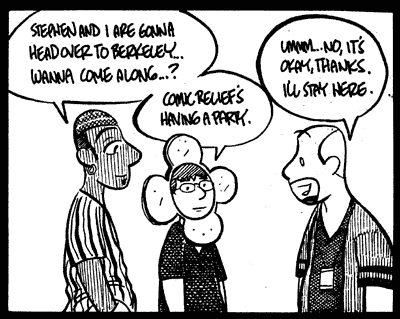
Later, I ran into the creator of , Stephen Notley. The guy actually wears a flower costume, and seems to have a brain that's just as random and genius as his comic. Really a neat guy to meet, he seems like the sort of guy you'd have a blast just sitting and talking to for a couple hours.

Lastly, (I don't think I forgot anyone, that would be embarrassing), I managed to meet Jeff Keane, the current artist (and son of the original artist) of , who was kind enough to knock out a quick sketch for me.

Perhaps at a later date, I'll post some photos I took, who knows?

Thursday, July 13, 2006

One nation, (out from) under God, part IV

There are a handful of phrases that seem to really set me off, and there's one in particular that I'd like to include in this series. "You can't legislate morality." The phrase seems to be brought up most often in the context of debates on homosexuality and legal matters tied thereto, but it can crop up in regard to any issue that is perceived by non-Christians as a Christian issue. Generally, I think it's crap.

To be fair, I've been thinking about this post for a few days, and in the process of mulling it over, I've realized that there is another side to this issue that I don't often consider. Once again, if one takes context and tries to find out what is meant by the statement, it may be that people using the phrase are saying something I totally agree with, namely that making something illegal won't change most people's attitudes towards it. Most places in this country have laws against polygamy, usage of certain drugs, sex with underage partners, and sodomy, but that doesn't stop those things from being done. Pretty much everywhere in this country and even the world, murder and stealing are illegal, and those go on incessantly. While many people think those items in the first list are immoral, and just about everyone thinks the latter items are immoral, I feel safe in saying that any of these acts are committed on a daily basis by someone who feels no twinge of guilt over them. In the case of the former, it's not real clear that they should.

Yes, if we were to make same-gender sexual intimacy illegal across the nation (as I believe it already is in a number of states), while it may change the sexual behavior of some people, it won't change a single homosexual into a heterosexual, as the definition of homosexual is not one of behavior, but of inclination. As such, it may be very well to ask what the point is of making laws that restrict the rights of what consenting adults do in the privacy of their own homes. I know I don't want the government monitoring what goes on in my bedroom, and although I am involved in a monogamous heterosexual marriage, it's quite likely if not downright inevitable that there are things I do with my wife that some people would like to see laws against. (No doubt, there are even some people who would like to see any sex at all illegal, although I would assume such people are few and far between.)

It must also be noted as an aside that the "between consenting adults" defense, while seeming to carry much weight, is far from conclusive. Other than perhaps strict libertarians, most people probably would have some reason that they would agree that the government should step in to a situation in which consenting adults are doing something in private. Think of a crack house perhaps, in which consenting adults are behind closed doors selling, buying and using harmful illegal drugs. Maybe you don't think so, but I think law enforcement should step in in such a situation.

With all of that aside, though, I did have an original point that I'm taking far too long to arrive at. Can we legislate morality? I believe that on a purely behavioral level, the answer is not just "Yes" but "Well, what else is there to legislate?" I suggest that not only can we legislate morality, we do legislate it and ought to, because in the end, it's the only reason to legislate.

As I said above, almost everyone agrees that murder should be illegal, and it is. Does it stop murder from occurring? Not completely, that's for sure, but I don't think that the fact laws exist to punish murderers do not stop all people from murdering, and the fact that they stop nobody who wants to murder from thinking about it, is good enough reason to simply not bother. If you believe that a certain action is wrong, then it is not just your right, but I think on some level your obligation to push for laws to be created to avert that action from occurring.

This is where this whole discussion fits into a discussion of the separation of church and state: People complain that it's not right for a president or a representative to push their Christian morality on the rest of the country, but I say, if the president is a Christian, what other moral base does he have to work off of? All of that indeed should be tempered with thoughts of the golden rule, and any elected official needs to think of the ramifications of any legislation they wish to support. If the government is given the right to peek in your bedroom and make sure you're not up to the wrong sorts of stuff, how will you feel about that? Is it really worth the loss of your own right to privacy to catch a few homosexuals in an act that, if it is indeed harmful, is only harmful to themselves? Maybe we even ought to rethink the crack house. What if powers-that-be outlawed alcohol once again, and the police broke into your house, caught you sipping a glass of sherry with dinner and dragged you off to jail? When the FBI comes to the house of a retired president that signed a bill outlawing sodomy, and catches him enjoying oral sex with his wife, how is he going to think about a couple years in the penitentiary?

So, we have to consider the pros and cons of every legislation, no doubt, but in the end, we outlaw certain acts because we believe them to be immoral. We reward things we believe are good, probably through tax breaks. Legislating morality is just what we do, and whether or not it's fair to do so is another issue entirely.

Wednesday, July 12, 2006

One nation, (out from) under God, part III

So, as you may have guessed from my previous posts, I'm pretty much in favor of the separation of church and state. So does that mean I think religion has no place in government at all? No.

I think something needs to be said about the whole controversy over public displays of nativity scenes and monuments to the Ten Commandments. While I think there was a much bigger outcry over the issue this last year from many people (I'm not sure who, as I heard about a lot of it more or less second-hand.) that may not have been warranted, I don't think it's unreasonable to be a little ticked off when you are told that having a nativity scene displayed in a public place during Christmastime is somehow against the law. What exactly is the problem? In a town near me, they have a very nice solution, I think. They have a major intersection in the town in which one corner has a nativity scene, one corner has a Chanukkah menorah, one corner has a Kwanzaa Kinara and the fourth has a big sign that says "Happy Holidays!" In such a context, how can the nativity be a problem?

Well, for some people it is, and we go back to the First Amendment again, where those who are a little more knowlegeable (as opposed to many who just vaguely feel that it must be illegal) point to the "establishment clause". For some people, apparently the mere presence of a religious symbol on government-owned property indicates the "establishment" of a state religion. That is to say, if the local courthouse has a large stone engraved with the Ten Commandments, the clear message is, "If you're not of a religion that regards these commandments as law personally, then don't expect to receive any justice here."

Now I myself would want to look at context. The fact is, such an assessment may be correct. The recent example of a nationally notorious judge who had installed such a monument in front of his courthouse and refused to move it, may have indeed been an infringement of First Amendment rights, since I seem to recall the judge was trying to make an affirmation of a belief that the American justice system must abide first and foremost by God's law rather than the law of the land. (Again, see my previous post if you missed it.) I think it's clear that this can't work in a true democracy, and I also think it's funny that I never heard conservative voices decrying "activist judges" during this particular controversy.

On the other hand, if a courtroom wanted to have a display that included the Ten Commandments alongside other documents that were historically important in the development of modern law--such as the Bill of Rights, Declaration of Independence, Magna Carta, Code of Hammurabi, etc., and whatnot--then why not? If all religions are represented, or if any religion that is represented is represented only insofar as it is important in a socio-historic context, then how is that "establishment" of a state religion? On the other hand, requiring that anything in the slightest bit religious be purged from the public eye seems to be setting up atheism as the state "religion". (Yes, I know atheism is not a religion, in case you were considering pointing that out to me; it is however often considered a religious classification.)

Back in February, I was on a business trip in Singapore. Once again, maybe this qualifies me as being a weird Christian, but I was delighted on some level to see such a wide variety of faiths openly on display in the city. It wouldn't be uncommon to walk down a street and pass an ostentatious Hindu Temple, witness a Buddhist festival, and spot a thriving church, all on the same block! I thought, why is it that we here in the United States can't just peacefully coexist side by side with people of other faiths, openly and warmly? Instead we have to do all we can to make sure that the religions of all others are suppressed.

Whatever happened to freedom of religion that caused it to be replaced by freedom from religion?

Thursday, July 06, 2006

One nation, (out from) under God, part II

Those who settled in America in the colonial years have a lesson to teach us. It's a lesson that I'm afraid some people have forgotten, and it's really too bad, because it's shown itself time and time again throughout history in one form or another. Religion and political power don't mix well.

As I've so often admitted elsewhere, and maybe a few times even here in this blog, history was not one of my better subjects, so I'm bound to get some details mixed up. Still, there was one story that I remember from a junior high class about American history. A bunch of guys in England got together and said, we're tired of being told how to worship by the King. We just don't have freedom here in England; let's see if we can find freedom in America. So they got a boat and crossed the Atlantic Ocean and founded Massachusetts, where people were flogged and burned as witches and heretics if they didn't worship the way the people in charge there wanted it to be done. So, a few of them figured they weren't any better off in Massachusetts than they were in England, and they went off to found Connecticut. What did they do there? Basically they set up yet still another little pseudo-theocracy, and the cycle started again. This led to the founding of Rhode Island.

I remember being about eleven or so and thinking, what a bunch of idiots! It's like saying you didn't like being abused by your parents, so you had kids in order to abuse them and somehow even the score or something. Well, not quite. Religion and political power don't mix so well because they share many characteristics. Neither one is inherently evil, but both can be and often are used in unscrupulous manners to control people for selfish ends. And most people wielding that power of control tell themselves that they are doing it for the greater good. All of these people, including the King of England, did what they did because they believed that God was on their side. This means to me that even though their deeds were questionable, they may have at some level had quite reasonable motives.

But are motives enough? Somebody's right (maybe), and somebody's wrong, but there is no guarantee that those who are in positions of power are the ones who are right. After all, the Bible itself is full of stories of powerful men who had control over Israel but were not considered righteous in the least. If there is no guarantee for a righteous King over God's chosen people, then who's to say that we as a nation that only *assume* we have God's blessing have any sort of guarantee of righteous leadership? God loves putting the wrong people in power to teach people a lesson through having to endure bad leadership.

All that aside, let me ask my fellow Christians: what sort of Christian country would we then live in? Both George W. Bush and Bill Clinton claim to be Christians, are there too many people out there that feel that both (or even either) of them was/is an ideal leader for our country? Do you think Baptists would be content with letting Catholics be in charge, or vice-versa? Look at the controversies over abortion, homosexuality, and gender roles that are tearing apart American denominations right now. Do you really believe we can hold the country together when we can't even hold our churches together?

Now does that mean that we can't allow our religious beliefs to play themselves out in the way we run our government? I don't think it does at all, but one thing we always need to remember is the "golden rule", and put ourselves in somebody else's shoes. Would we be okay with somebody else making these same decisions that we make? Somebody else running the country the way that we run it? If the theists tell the atheists that they won't be allowed to live as they see fit, then how do we know that tomorrow the monotheists won't take away the rights of the pagans and Hindus, and the next day the Christians take away from the Muslims and Jews, and the next day the Protestants take away from the Catholics and Mormons, and the next day the Baptists take away from the Methodists and Lutherans, etc. Maybe the "slippery slope" isn't considered a valid form of argument, but I just see a set of events lined up that, if we took away the religious rights of one person for an arbitrary reason, would lead to virtually nobody having freedom anymore.