Showing posts with label cynicism. Show all posts

Thursday, October 23, 2008

Add It Up

Today, another rant about a Newsweek column; this time, it's not Anna Quindlen, but the topic is definitely strongly related to feminism.

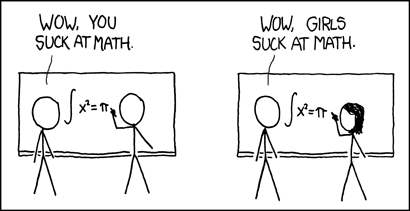
Sharon Begley, Newsweek's science columnist takes a moment to speak up on a subject near and dear to my own heart: sexism and stereotypes about learning ability. ("Math is Hard, Barbie Said") See, just in case you're not aware of it, American girls have a hard time with math, generally finding it too challenging for them, and thus we find that there is a clear gender gap in ability and achievement in this area. The thing is, though, it's all (as they say) in their minds.

I love parenthetical statements, don't you? (Okay, maybe it's just me.) "As they say" is really the operative phrase here. The fact is, while girls in America and Japan have consistently lagged behind men in mathematical ability, that gap has been far narrower in communist nations where supposedly they take a more liberal view of the ability and worth of the individual, regardless of gender. It would seem--and to many of us, there's no surprise to this--that girls do badly in math because society has told them that they will have this failing.

The result, according to Begley is something more than simply a self-fulfilling prophecy of "Tell somebody they can't do something, and they probably won't be able to do it," but actually an emotional response. Tell a girl she can't do something, and even if she doesn't believe you, the fact that you gave her discouragement will cause a distracting emotional reaction. How well are you going to be able to focus on factoring a polynomial when half your brain is screaming out to you, "How DARE they say that!"

This fact is very personal to me for two reasons. One of them is that despite that my degree is in mathematics and I know I tend to be very good at it, there was a time around fifth and sixth grade when I struggled with math. I had a couple of math teachers who, instead of encouraging me to do better, essentially took time and effort to embarrass me and tell me I was a failure. I never considered the fact until just now what a boon it was for me to have a seventh-grade math teacher who was completely incompetent. I've always wondered how a guy like that ended up teaching math when he obviously had no skill in the subject, but in retrospect, I wonder if it helped stroke my ego to recognize that my own ability was better than the teacher. (This was the first of many teachers that I had the habit of viciously correcting on a daily basis, pointing out his errors at every opportunity, which came frequently. On the same note, it was probably oddly useful for his ego that he clearly just didn't care.) I realized long before seventh grade that mathematics was the method of understanding reality on a basic, foundational level, and seeing it taught with such ineptitude goaded me into always being the best I could be.

But I was lucky. As a boy, when I showed ability in math and science, society approved and egged me on to greater achievement. The second thing that's always bothered me about this topic, and this one even more so and more repeatedly at every chance it had to come into my mind, was the fact that my sister did not go into a college major in math or science. Sure, all things being equal she might still have chosen the path she did, and I'm not aware of any regrets on her part; she's been very successful in the things she's set her hand to as far as I am aware. What irks me is that I do feel she was shorted in the area of praise for her abilities. I became the math major in college, I was the one that people actually called a "math genius" repeatedly in high school. (Note that when you go to a small-town high school, and then graduate to a large university, you tend to find that most areas where you were considered excellent are now areas in which you are merely average; I don't claim to be anything special today.) Nobody ever called my sister a "math genius", but I always suspected that she was far superior to me.

Once when visiting home from college, I was rummaging through some papers in my mother's house, and came across some standardized test scores. A test taken sometime towards the end of elementary school revealed that while I was above average in my mathematical aptitude, my sister was truly the cream of the crop. Yes, my sister was the real "math genius", but where did that genius go? Fast forward from elementary and rewind from college to the beginning of my senior year. This is the time that you start looking at your grades and test scores and pick what schools you want to look into. The school guidance counselor called me into his office and informed me of what was supposed to be great news. I knew my SAT scores were good, but apparently, in my small rural county of Northern California, I had set the record of highest-ever SAT score. I might have reveled in that announcement if it weren't for the very following sentence with came before the first had a chance to sink in.

"And the person who previously held the record was your big sister!" I was told with a big grin. How about that, Brucker? Consider the irony! Oh, I did.

"Uh... Was my sister informed when she had set the record in the first place?" I asked. "This is the first I've heard of it."

The smile disappeared. "Um, well, I guess not."

"Why the hell not?!" I responded through gritted teeth, and I got up and left. I was always somewhat aware of the problem, but that day, it hit home in a special way. Friends come and go, but my sister will always have a special place in my heart, and I couldn't forgive the injustice done to her or to all our sisters everywhere. As I said, I get the impression that my sister was satisfied with the academic course her life took her on, but I can't help but feel that nonetheless she was robbed of a full set of options.

Thus comes the real problem, the larger problem as I see it. Sexism and racism aren't just bad, but hurtful things that cause often nearly irreparable harm. Our society is closing down gaps all over the place, but will the wounds of the past ever be healed? Within a few months, it appears we will likely have our first black President, but will a single black President make up for centuries of slavery and oppression? When the day comes that a woman is placed in the Oval Office, will that make up for all the years they were treated as slaves in attitude, if not in name?

Prejudice says, "We're not going to allow you to be equal." When pressed, it says, "Okay, you can have the right to be equal, but you will never really be equal." Eventually, after centuries of beating down the oppressed, be they members of a race, gender, or other social group, the members of the oppressive group ask the oppressed group, "Why are you so bitter about all that stuff? It's in the past!" There is a tendency to miss the fact that the fight against oppression is an uphill battle, and even when the playing field is leveled, it's hard to shed the weight of the past.

When Begley points out that the very fact of being told that you can't do something impedes the brain from doing it, she points out that it doesn't have to be personal. A girl doesn't have to be told that she is incompetent in mathematics, she need only be told that historically, women have underachieved in comparison to men, and the discomfort that sets up in her mind is sufficient to impede her thought processes. This is the sort of thing that goes beyond self-worth, and turns into an evaluation of the worth of the group to which one belongs. We tell people that they are inferior for long enough, and some of them believe it; among those who have the determination to not believe it, more than a few will still be burdened by the injustice of the sentiment.

You don't have to be a member of an overtly downtrodden group to experience this for yourself. Think about the situation we have here in America with respect to the learning of foreign languages. There's a joke I've heard a few times that goes like this: "A person who speaks two languages is called bilingual; a person who speaks three languages is called trilingual. What do you call someone who speaks one language? An American." Why is it that Americans have such a hard time learning foreign languages, but so many Europeans and Asians seem to typically speak three or four languages? I know Americans in general won't accept the argument that these people are somehow intellectually superior to us. I personally believe that we as Americans don't learn foreign languages because we've decided it's just too hard. This is not something indicative of any subset of the culture of the United States, but seems to pervade us in general. We either believe that we just can't do it, or we think we might be able to, yet we look around and note that few people are doing it and get discouraged. This isn't even the result of anyone acting prejudicial towards Americans, but merely a culture that has shifted into a sort of self-prejudice. Imagine if it were a matter of prejudice; instead of simply struggling through your language classes worrying about how difficult it is to conjugate verbs and learn the gender of nouns, you also have to keep thinking about how everyone's expecting you to fail.

But here's where my cynicism cuts in and takes over again. Begley points out that things are getting better for women, and they are beginning to be accepted more often as the intellectual equals of men, but will equality--true equality--be realized in our lifetime, if ever? If we as Americans can slip into a feeling of hopelessness over our inability to acquire languages without any sort of external oppression, how can people who have been actively pushed into a state of hopelessness rise above it? Perhaps asking such questions is largely adding fuel to the fire, but it needs to be said anyway.

I don't believe that we escape the evils of the past by simply trying to forget that they ever happened. We escape from them by actively fighting to overcome them. As a father of two daughters, there's a significant battlefront of this culture war located within my own household. It's a hard responsibility that's been given to my wife and me to see to it that our daughters are never told that they are any less capable of anything simply because of their gender. Really, that's the only thing we can do: try our best to raise up a new generation better than the past. Do we do this by never mentioning the sins of past generations towards their mothers and grandmothers, or by entreating them to actively strive to overcome the vestiges of that shameful past? I don't know the answer to that. Maybe it would take a woman to figure it out?

Tuesday, October 21, 2008

Long Train Runnin'

So, now I get to commute to my new job via train. I like it, to some extent, but in some other ways, it represents a certain loss of innocence. There's a magic to trains that can very easily get lost.

I don't know where this magic comes from. I do think I'm not imagining it, however. Think of a movie like The Polar Express, in which a train takes children away to meet Santa Claus, or various movies like the serious thriller Runaway Train or comedy Throw Mama from the Train in which people in trouble with the law make their final bid for freedom via the rails. There's this feeling that seems to subtly pervade the culture that says that a train is the way to get away from your problems to somewhere better. This is the real story of the Little Engine That Could.

For me personally, I had actually put a start to a story I was going to write--and who knows, I still might get it done--about my personal take on the whole phenomenon. For me, I think I know exactly what it was. When I was in grade school, I used to live in a house right next to the freeway, and on this particular stretch of freeway, there was a set of train tracks running up the middle. I remember lying in my bed at night, listening to the sound of the traffic, and the occasional clack-clack noise of trains moving along.

I lived next to the freeway, but personally, I never took it. My school was actually on the exact same street as my house, but on the other side of the freeway, so every morning, I'd walk through an underpass to get to school, and when I arrived, I could look back and see my house from the top of the monkey bars. On a regular daily basis, I essentially went nowhere. But trains and freeways? Those went places.

Once, I went on a train trip to Portland to visit my favorite cousin. I got to travel with my grandmother, of whom I was very fond. I remember spending a great deal of the trip sitting in the lounge car, which was all windows, and one could look out and see scenery. Not the same scenery every single moment like one sees at home, but new scenery all the time, always changing and scrolling by, and I can almost hear my young mind thinking, "This is very beautiful, but we're leaving it behind to move on to something new and exciting, and each piece of scenery will somehow be more exciting and beautiful than the last."

I was definitely smitten, although it may not have been just trains. Maybe it was the freeway as well, and time has made me forget much of that. After all, the thing that greatly enchanted me more than anything was the idea of moving, of going someplace new. Freeways will do that, and airplanes most of all, although for me, airplanes may have been more routine (I flew a lot as a kid), or perhaps they just seemed too much like nothing was happening with the scenery so far away that often all there is to look at is the clouds.

Of course now, here I am on the train, and there isn't much to see anyway. As I write, it's six in the morning, and outside the window is largely just an expanse of blackness with an occasional lonely streetlight flitting by. This is what I dread. Even when the afternoon brings me back, and when the seasons change and allow me to see the scenery during the morning commute, the scenery will still all be the same. Every day, I will take the same train, pass the same landmarks, arrive at the same destination, and all of this will become routine. As it is, even so early in my train commuting experience, there is a decided lack of excitement. The wheels of the train turn over and over, and the same expanse of track will take me back in a few hours. Tomorrow, I will repeat the trip, and the day after that.

Instead of the excitement of the wheels turning to take me somewhere new, the time comes that this is routine. I remember in college, I had an astrophysics professor who scoffed at the Ptolemaic model of the universe, which envisioned the stars and planets fixed in circles upon circles in the sky. I don't think he (Ptolemy or my professor) thought that there were supposed to be literal physical circular structures affixed to the dome of the sky, but my professor thought the whole thing was ridiculous, saying, "If you get enough circles, you can map out any path, so what's the point?" I thought it was very clever, since the Ptolemaic system was surprisingly accurate for being "incorrect". Today, we understand that the planets travel pretty much in ellipses, which are very circle-like. We live on a globe that turns about roughly once per day, and travels around our sun in a roughly circular path, while that sun travels in a circle around the galaxy.

See, everything goes in cycles. There's our daily cycle, and most of us have five daily cycles that fit into a weekly cycle, and fifty-two weekly cycles make a yearly cycle. Various aspects of our government run in two- four- or six-year cycles, and the U.S. conducts censuses in ten-year cycles. All of that cycling becomes rather routine. The fact that we're on a hunk of rock that flies through space on an elliptical path with a radius roughly 93 million miles should be fascinating, but by the time we're old enough to fathom the concept, we realize we've already been riding that path for numerous repetitions, and it's almost instantly old hat. Space travel? No biggie, I've already travelled at least twenty-one billion miles through space just within our solar system. Going just to the moon is a snorefest in comparison.

So here I am on the train, but I'm not convinced it's really taking me anywhere. It's a shame, and not just because of my supposed disillusion with trains. Really, I ought to be looking at it differently, and precisely because of that 93 million mile ellipse, and because I've taken a plane about halfway around the world before. There's a romanticization involved with the idea of moving in physical space, but even when we seem to be holding still, we're moving at a great rate, all the time. People are always riding on trains and driving on freeways. (As a child, I remember the sound of the freeway never completely stopped, but went through a cycle of intensity throughout a 24-hour period.) In our modern society, where everything is moving quickly all the time and information travels around the globe in an instant, the only real movement that matters anymore is socio-economic movement.

I remember I scoffed at the fact that Engels, that idealistic co-author of The Communist Manifesto happened, in his spare time when not subverting the dominant paradigm, to be the owner of a factory. Hypocrisy? Maybe, but then, how can one change the world without money? They say money makes the world go around. Well, some do, while others say love. Others still in ancient times said that it was the heavenly spheres set in motion by the gods, but in modern times, we know it's really the forces of gravity. Ramble, ramble, ramble, do I have a point?

Physical mass is what makes the physical world spin. What makes the socio-economic world spin, if that's the movement that really matters? Well, it is money and love after all, isn't it? I have a great deal of love for my family, and most of the best ways to express that love involve money: providing shelter, clothing and food; giving them gifts for fun; enjoying entertainment together; all sorts of things. Love and money provide inertia for the non-physical world, and we all need both of them, in one form or another.

Why am I taking the train? What's the real purpose of this movement, the beginning of a repetitive series of motions in which train wheels will turn thousands of times along a track to carry me to place where I will perform repetitive motions and climb aboard another train that will carry me back, rolling along those very same tracks to return me to my starting point? The moving of myself as an object to another location, just to put that object back again over and over, day after day? Physical movement is just a means to an end. I'm here because of money, which I don't like, but I need it. I'm here because of love, which is difficult, but I want it.

In order for the train to move hundreds of miles away, the wheels have to turn around and around in a tiny little radius; in order to make the wheels turn, the pistons of the engine have to shift back and forth along a short little path. Repetition, repetition, repetition, do you have a point?

By going back and forth, those little movements get translated into larger movements, and those (relatively) tiny little wheels on the train move the whole world. There's a sense of magic in that, it's just not so romantic unless you let it be. When the train approached my station, I leaned forward and eagerly strained my eyes to see what the day would have in store for me. I think there's still hope for me.

Tuesday, February 26, 2008

The jury is out...

Many years ago, I had an opportunity to serve on a jury. I really do view it as an opportunity, too. I don't understand why so many people bitch and moan when a jury summons appears in their mailbox; for the average person, serving on a jury is the only chance we'll ever have to hold public office. Really, let's not forget that: Chances are about zero that you'll ever be President, probably less than 1% you'll serve as a lesser elected representative, but all you need to be part of the American judicial system is a mailing address.

Funny, while I was waiting to see whether I'd be called up for a jury, I found myself remembering Ned Roscoe. Ned Roscoe doesn't seem to have his own website or even Wikipedia entry, but he is a bit of a second- or third-rate California political celebrity. When I was in high school, Roscoe ran a chain of grocery store/gas stations known as Cheaper! stores. The prices were incredible, and there was some entertainment value in the Libertarian rants that Roscoe put on posters throughout his stores and on grocery bags. Roscoe later went on to shut down most if not all of these stores, and open a mega-chain of tobacco shops known as Cigarettes Cheaper! which I haven't seen lately, so they may have gone out of business. Roscoe was later one of several hundred failed candidates for Governor of California in 2003.

Why was I thinking about Roscoe? Well, one of his grocery-bag rants that I actually read all the way through (they would cover all five sides of the bag) was one entitled "Want to get out of jury duty? Bring this bag with you!" Upon that bag, he expounded at length about how the government doesn't really want you to know your rights as a juror. Though I'm not a Libertarian, a lot of my views about juries have been profoundly affected by what was on that bag, oddly enough. He pointed out that, as I said above, being on a jury made you a part of the government, and that our government, built as it with with those "checks and balances" that we love to talk about in civics class affords you incredible power as a juror. Those checks and balances aren't just for the President and the Supreme Court, but also for individual members of a jury! As juror, you have the right to disagree with the rest of the jury and hang the case, not only if you disagree on the facts, but if you even disagree on the moral basis of the law undergirding the matter. (It's funny, but I've always thought with all the fighting over the legality of abortion, the fact remains that you'd be hard-pressed to find twelve people picked at random out of the general populace that would be willing to put a woman in prison for having an abortion, regardless of the legal status. That's another matter, though.) Sitting in the jury selection room, I assured myself that if I were chosen to serve, I would have no problem hanging a jury if my conscience told me it was the right thing to do.

As it happens (and as I already said) I did end up on a jury that day. The case was actually largely unremarkable. A woman had been injured in an auto accident, and the defendant had already been found guilty; it was only our job to listen to the facts and decide what was the monetary value of the woman's suffering. How do you really put a price tag on suffering, though? This woman had gone through years of physical therapy, and various treatments by a variety of medical practitioners, but the lawyer arguing the defense made the case that the claims made by the plaintiff were frivolous, and had much more to do with her age than the after-effects of the accident. Indeed, the day of the accident she was X-rayed and it was found that no bones were broken, and the problems she had been having with her back since that day had to some extent been caused by osteoarthritis, if I remember correctly. She was claiming a problem with her foot that had developed several months after the accident was indirectly caused by the accident. It was all pretty strange, but she wanted money for time lost from work, pain and suffering, medical bills, and probably one or two other things I don't recall.

As the case ended, and we filed into the deliberation room, I was thinking, "Eh, this woman doesn't deserve squat. Her car was paid for, so at most, maybe a couple hundred for medical bills." Then something strange happened.

One of the older members of the jury (I think I may have been the youngest) was the first to speak up after the door closed. He actually said more or less what I was thinking. "This lady's nuts; we shouldn't give her anything!" Everyone sat down, nodded, and the murmured general consensus was that this would be a pretty quick deliberation.

And I lost it.

Somehow, I just couldn't let it sit at that, even though I largely agreed. "Look, the stuff about her foot's pretty ridiculous, but nobody is disputing the fact that she was hurt, right? Shouldn't she at least get some portion of her medical bills paid and a tad for pain and suffering?" Before I knew it, we were all in agreement that she deserved some sort of settlement.

I don't consider myself a strong personality. I'm not a leader by any means, and I wasn't elected jury foreman. Nonetheless, in the course of the next couple hours, I had the distinct mental feeling of holding the reins of a team of eleven horses and guiding them wherever I wanted them to go. My initial misgivings about holding silent in case there were others who had a dissenting opinion that they were unwilling to voice in the face of opposition gave way to a new misgiving. Was this a group of twelve people who simply would make the decision that aligned with the loudest voice in the room? When the deliberation was done, the plaintiff was awarded a few thousand dollars, but I kept having the feeling that every dollar she got was hung on my own words to my fellow jurors, who, whatever they may have felt about the case in reality, were far more interested in agreeing with my vocal majority of one and getting out of there.

Did I imagine it or was it real? If it was real, which I strongly suspect, does it say something about our attitude towards jury duty, or about our tendency towards a herd mentality in general? Personally, I don't like to think of the implications of either possibility. I fear often that people either don't think for themselves, or they simply don't care to think about anything beyond personal convenience. Like I said, I'm not a strong personality or a natural leader; what happens to our society when someone who is stands up and steers us towards their own personal ends?

Wednesday, February 20, 2008

Hindsight is 20/20 and color-blind

Sometimes when I write these posts, I mull over a subject for a few days, and then commit my thoughts to the blogosphere, where surely few will read them, but at least they're out of my brain for a while. Today, I'd like to rant on something that either has occupied my mind for less than an hour (I was sparked into considering this subject by something I caught on television less than an hour before I started typing) or for most of my life (this subject has interested me since I was a kid; I guess I've always been a bit of a cynic).

Racism and closely related topics are often difficult to talk about for a number of reasons. It's a sensitive subject obviously. It's something ugly that we would rather just go away. It's something that most of us harbor in some form, although we hate to admit it to ourselves. Let me come out and make an admission: I have a certain amount of irrational fear and hatred towards Germans. I think admitting it to myself helps me deal with it, but it's still there. Being raised Jewish, my older family members and people within the Jewish community talked a lot about Nazis. As a young man, I didn't really understand what the term meant, other than knowing that in my father's lifetime, a lot of Germans killed a lot of Jews. Thus I associated an (arguably) irrational fear of Germans, making an internal association due to a limited grasp of history that rationally I know to be false, in general, but still get the creeps about nonetheless. So there's that off my chest.

(For some people, it's not racism, but some other form of prejudice: I once knew a guy who had had a bad employee who had graduated from a certain college, and ever since had not liked anyone he met who was from that college. A lot of us have a certain degree of sexism as well that manifests in many differing ways.)

Maybe is just that I am a cynic, but I think if we are honest with ourselves, we won't look at racists and say, "I'm so much better than them," but rather,"There but for the grace of God..." The thing that sparked me this morning was a children's program talking about racism (I think; I only caught about a minute while channel-surfing). A young white girl was asked to imagine herself living in the early part of the 19th century, in a family that owned slaves; how would she feel? She responded, "I would feel really bad about it..."

Would you really, though? It seems more likely to me that you would take it in stride. Obviously most of the people who lived in what would later become the Confederate States of America took it as a given that slavery was acceptable, proper and even good. It was necessary for the thriving of the cotton plantations and other agriculture to have a constant supply of cheap labor, and so slavery continued. Tell me, do you feel bad for migrant workers in 21st-century agriculture who work all day in the hot sun for less than minimum wage to feed their families, knowing that they will probably never be accepted by mainstream culture? When you think about it, it's a lot like the early days after the abolition of slavery in the South, when many former slaves had to stay working on their old plantations without pay because it was the only way to make a living in a culture that didn't want you to get ahead, slavery or not.

Why do you suppose it is that it seems so obvious to us today that slavery is wrong, and yet there seems to have been few people who voluntarily gave up their slaves before abolition? In Santa Cruz, there was a local historical figure named London Nelson who was a freed slave. His first master died and left him to his eldest son, who continued to use him for cotton picking. Eventually, Nelson was set free when his new master decided to go west in the Gold Rush. The story interests me because it seems to illustrate the point that on the whole, the way we humans treat our other humans has less to do with what we feel to be morally right, and more to do with what will bring us economic prosperity.

I actually recently discovered that there is a shocking (but perhaps not surprising) strategy that some businesses use to dispose of wastes of certain kinds. Electronic equipment is recognized to be very dangerous and toxic, being filled with lead, mercury, cadmium and other deadly substances. It's illegal to put electronic waste in American landfills, so the preferred method is to break down old computers and extract the toxic substances, recycling them into new computers. That's difficult and costly to do, however, so many companies have found a cheap alternative: ship the stuff to India, where there are no laws about dumping these substances. Thus, our toxic chemicals end up in landfills sometimes literally in the back yards of impoverished Indians. I found myself thinking: the Nazis killed off millions of Jews out of hatred, but if Americans kill off millions of Indians out of mere convenience, who is worse? I don't know, but it really bothers me. If I am a person who stands by and lets this happen, am I any better than the average German citizen who didn't stand up to the Nazis? Heck, my life wouldn't even be put in danger to stand up to this sort of evil!

One of the unfortunate things about prejudice is the fact that most of us don't notice it or confront it unless it's directed at us. Remember the movie Philadelphia in 1993? Tom Hanks plays Andrew Beckett, a gay lawyer with AIDS who sues his firm for wrongful termination because he believes he lost his job in part because of homophobia. On what does he base his claim that his employers were homophobic? In a flashback, we see a group of lawyers together at a gym, swapping jokes as follows:

What do you call a woman who has PMS and ESP at the same time?

I don't know, Roger, what do you call her?

A bitch who knows everything.

Sounds like someone I know.

Hey Walter, how does a faggot fake an orgasm?

He throws a quart of hot yogurt on your back.

The thing that bothered me about this scene from the first time I saw it was the fact that Beckett is laughing along with the others when the sexist joke is being told, but the smile melts away when the gay joke is told. I wanted to step into that scene and ask him, "So Andrew, it sexism better than homophobia? If telling a joke about 'faggots' means they must hate you, does that imply telling a joke about 'bitches' mean they hate women? Why were you laughing before, and why did you stop now?"

I remember a time when I was at work alone with a co-worker who said, "Hey, all the women are gone, let's tell some politically-incorrect jokes." He proceeded to tell a black joke, a Polish joke, and a Chinese joke, laughing up a storm. I laughed too, then I told him an Italian joke. My (Italian) co-worker said, "Ouch..." and joke time was over.

Don't think you're better than anyone else just because you're not a Nazi. Most of us aren't Nazis, and most of us aren't particularly nice.