Showing posts with label challenge. Show all posts

Monday, August 21, 2006

Rising to the Challenge, part III: Dog on, "Well, it's DNA!" and still, "Ew, no God."

I'm going to take a moment to go back to the comments of both Zondo Deb and Jono, and continue to expand on a concept I touched on in part I of this series of posts.

What if there was found in nature a message that unambiguously pointed to a higher power? Call me naive, but I still think there is. It's a message found inside every living thing on the planet, and it's called DNA. Now I admit I'm no biochemist, or whatever it is one might need to be to become an expert on DNA and all related sub-cellular information-carrying and processing molecules, but there is something fascinating going on at the microscopic level in living cells. Maybe it's the sort of thing that one would write off as creationist propaganda, but while I realize some creationists like to grasp at scientific and pseudoscientific straws, a lot of the things I plan to discuss here were things that I had mused over back in the days before I was a Christian, and I've never been a strict Biblical Fundamentalist Creationist. (Some of my views on creationism can be found at my other blog, mostly back about a year ago.)

What is DNA? It's a complicated molecule that carries within it a sort of chemical code. The code is written in four different chemical letters called "bases" which essentially come together to form various three-letter words that spell out sentences called "genes". Those words correspond to amino acids, which according to the gene they are in will be strung together to make a protein. Human DNA has about 3,000,000,000 bases which code for about 30,000 genes.

Now, admittedly human genetics are more complicated than those of lower forms of life, but you have to consider that the complexity goes down to a cellular level. Each individual cell of any living creature is made up of complicated little machineries which exist to process fluids, move minerals and burn fuel. The various genes coded onto DNA are accessed to formulize the creation of all the little proteins that make the parts that run the machinery of the cell.

Imagine trying to create a functioning automobile out of tinker toys. (Such a car would be huge, but scale isn't so important in imagining it, as the tinker toys at the cellular level aren't visible to the naked eye.) Just imagine fitting together tiny little pieces to make a machine that can transport things from one place to another under its own power, and has the standard amenities like power steering, anti-lock brakes, etc. That's an approach to the complexity that exists in a cell, but a cell is actually far more complicated than that. And aside from the complexity of the structures that make a cell simply function, there's also the fact that living cells have the property of self-replication. That is to say, imagine not only building a car out of tinker toys, but in the engine of your tinker toy car, you've got a sort of tinker toy encoded blueprint of the car that, rather than sitting there statically waiting for some tinker toy virtuoso to come along and read it to build another car, the car itself will gather loose tinker toy parts it finds and build more tinker toy cars as part of its normal function. Imagine building a car like that made from any material! And that's just a cell; imagine the further complexity of building a whole body!

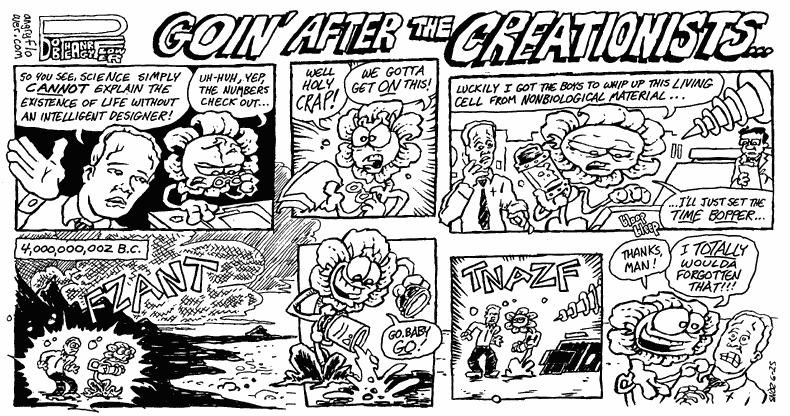
Irreducible complexity is a popular concept among "Intelligent Design" proponents these days, but has some serious flaws scientifically, some of which I expect to address at a future date. The thing that really fascinates me, and something I've never heard addressed by any ID people, is a sub-cellular chicken-or-egg problem. (I actually heard this from an author who I believe is an atheist.) You've got DNA, right? It's a coded message that tells you how to build a human being, an amoeba, a redwood tree, whatever sort of massive "tinker toy car" it's a part of. How is the code read? Well, there are various sub-cellular structures such as RNA that serve various purposes like reading the code off, gathering the appropriate amino acids, stringing them together, checking the code for errors, making copies of DNA, and even cellular-level immune systems to protect from virus intrusion (these are totally separate from the system-level immune systems such as your white blood cells). All of these structures and systems are like the hardware on which the software of the DNA code is run.

Where does that hardware come from? Answer: it's built from certain parts of the code integrated into DNA. So you can't have the machineries that build living things on the cellular level unless you have the machinery to build them already in existence. Put raw DNA in a beaker and wait to see what happens. Nothing. Try with water, cold or hot. Nothing. Add a bunch of carbon, nitrogen and trace amounts of other important minerals. Still nothing. How about a warm soup of amino acids in varyingly oxygenated and heated environments? It will do nothing. Nothing whatsoever. No, DNA only functions in its natural environment, surrounded by a living cellular structure. And living cells don't come from nowhere.

So as usual, getting to the point after a wild series of paragraphs of blah-blah-blah-blah... Where does life come from, if not from an intelligence that is not life, at least, not as we know it? A DVD without a DVD player is useless, and vice versa. DNA without life does nothing, and if you somehow could remove all the DNA from a living organism, it would cease to function in fairly short order, and certainly would never fulfill its primary evolutionary function, which is to reproduce itself. So it seems logical, to me at least, that there must exist (or once have existed) an intelligent being that is not an earthly life form. While that intelligent being may not be "God" in the sense we tend to think about it, I have a hard time thinking of any alternate ideas that don't approach ridiculousness. It is for this reason that I have been fairly confident that there is a divine Creator, even in the days before I was a Christian.

I'd love to hear anyone's thoughts on this.

Friday, August 18, 2006

Rising to the Challenge, part II: A freakin' miracle!

Back from my short vacation (or maybe longer one from the Internet if I don't finish this until Monday) I resume my commentary on the responses to my "" inspired in part from my posting on Goosing the Antithesis.

I might as well address the response given by Sharon, who, although not an atheist, is very close friends with one who makes an interesting suggestion that God might simply alter our brain structure so that we become believers. Aside from the logical problems I have with that and address there, my desire is definitely to address the question with the understanding that free choice continues to be a part of the process. (On a side note, if free choice does not exist anyway, then the question is in many ways meaningless.)

Finally getting back to the response by bookjunky, he makes one of the best suggestions I have heard, I think. He suggests that if the earth's rotation were reversed without harm being caused to life on the planet, that would be a clear-cut miracle, as such a thing should simply not be possible. I think this is a good answer, as this indeed would be hard to explain, and pretty much impossible as a natural phenomenon, as he suggests. The following suggestion that God would need to give an explanation to everyone on earth is probably a necessary part, as the miracle itself would have no reference. Some people might find it hard to fully understand why, but Jesus coming back from the dead or raising someone else from the dead is more meaningful than someone coming back from the dead without some sort of prophet around. A miracle without context is interesting, but meaningless.

Other suggestions given are parting the Pacific Ocean, and moving of the stars to spell out a message in all languages (possibly a logical impossibility). This latter suggestion is also essentially given by Jono. All interesting responses, but I believe flawed at their heart for the real reason I think is at the center of this question. As bookjunky says:

Would I then believe in a Christian version of God? Hell, no.
Ouch. I think this is significant. Is it enough to simply believe that there is a higher power out there, or is it necessary, in God (be it the Christian God or not) wanting us to believe, that we believe properly? This seems to be a foundational truth of most religions, despite some people claiming the contary. It's not enough just to "be sincere in your belief". You have to be sincere in the belief of the right thing.

Hey, maybe there's a good reason somebody has to disbelieve in the God of the Bible. Then again, there are some people who feel that they have good reason to disbelieve that God exists at all in any form. That's part of what makes Francois' response so appealing to me. He doesn't simply say he has no answer, he positively asserts that the answer does not exist! Even though I happen to believe in God, I, too believe there is no answer to this question, specifically because of our will to deny whatever we will. It may be faith, it may be logic, it may be a number of things, but there are people out there who do believe, people out there who would be willing to believe (or think they would), and people who will not believe. I don't think God can please them all.

Tuesday, August 15, 2006

Rising to the challenge, part I: My goose cooked?

Well, as I may have hinted in my last post, I have a number of subjects on deck, so to speak, and just haven't gotten around to polishing them up and posting them due to them being not up to my usual quality (insert self-deprecating blog humor here). In particular, let me foreshadow that I had a few things to say about the evolution vs. creation debate that I think will be thought-provoking, but maybe I'll break it down into several posts like I did with the separation of church and state posts (1 2 3 4).

At the moment, I am going to go back and revisit one of my previous posts that's one of my favorites, and has now become a much more popular one thanks to my sneaking a link into a much more popular blog. I think the post itself doesn't need much in the way of restatement, but various responses I have finally received lead to further discussion.

Francois Tremblay says something that I think cuts to the heart of the matter, partially because I asked for an opinion on whether the suggestion of God proving Himself or my responding challenge really has meaning. He says "it is quite impossible for us to know that any given event is non-natural" which I hope believers in the supernatural will see to be quite true! Hypothetically, if there was an event that was non-natural, how would we be able to tell? (I may take this in more detail as a future post soon.) He also points out that believing that God could exist implies living in a completely different mind frame than believing that God could not exist. What little significance the "atheist challenge" has, if any, depends largely on what sort of atheist a person is. A person who knows God does not exist will see it differently from a person who is of the opinion that God does not exist, who will in turn see it different from someone who simply doesn't know whether God exists or not.

On a side note to this last point, I've heard atheists make the clever comment that most people are atheists of some sort or another. I may believe in Jesus, but I am an atheist in respect to Zeus, get it? So one interesting restatement of the original question that will allow Christians and other theists to play along in this sort of philosophical train of thought is:

3: Give a hypothetical undeniable proof of the existence of the God of the Quran. (If you're a Muslim, you could still use the wording of challenge #2.) Essentially, suggest a way that "Allah" could send an unambiguous message to the world so that everyone could understand fully that our purpose in life should be to follow the teachings of the Prophet Muhammad. You may have a good answer, or you may see from this perspective why the original question is not so meaningful.

Bookjunky makes some suggestions that I think are very good, but I will save for my next post. Partly because I he reposted much of his comment in my blog, and I'll respond to those posted here separately, and partially because his response is in an odd fashion related to Zachary Moore's response, in which he points out that while surely there may be miraculous signs that would make you give consideration to God, you might still not "worship a being so immoral". This is oddly enough a more difficult hurdle for people who do not believe than lack of physical evidence. People don't believe because they don't want to, and they feel perfectly justified in denying a perceived cruel deity.

Zendo Deb refers to the ending of Carl Sagan's book "Contact", which he says was "expunged" of all religious references when made into a movie. Oddly enough, I found "" to be an incredibly spiritual movie myself, so I'm more eager than ever to read the book, which is high on my list of books to read sometime soon. His suggestion?

Obviously non-random information would have to be hidden in various computations. The digits of pi, when expanded to some large number of digits would be seen to contain certain messages, and so on for other non-rational real number representations.
I find this a fascinating suggestion, and one that I could devote a whole series of posts to. I may do at least one. My thought on this? In the movie "Contact", Jodie Foster's character hears some radio pulses coming from outer space and says, "Those are primes! 2,3,5,7, those are all prime numbers and there's no way that's a natural phenomenon!" If the pulses did come from a natural phenomenon, say a radio source that had a fifty/fifty chance of either pulsing or pausing, the chance of that particular sequence coming up is one in 1,048,576. That alone was enough to convince her that this was not natural, but on top of that, there was encoded within the signal the blueprints for a massive and complicated machine.

For me, the idea that we could discover a complicated code that gave instructions for the building of an elaborate machine that was not created by human intelligence would be evidence enough for me to assume a higher intelligence was out there and was interested in talking to us. Of course, as far as I'm concerned, that's a good description of DNA. Living things, down to the very cellular level are perplexingly intricate machines that are far beyond the ability of any human engineer to design. This message is obviously not unambiguous enough for everyone to believe there's something more than mere random effects of evolution walking about on our planet, but for me it tends to be enough to wonder. Is it enough for Zendo Deb or any other skeptic to at least consider agnosticism?

Thursday, June 01, 2006

Challenge to atheists: prove God exists

Okay, this is essentially a reprint of the post below, but that one doesn't show up on Technorati right, and someone (Wade, whose new atheist blog is here, so give him some traffic) commented that the challenge was actually worded a little vaguely. To review, I have had many atheists/skeptics claim that if God really wants us to believe in Him, He ought to give "undeniable" proof of His existence. My contention is that there is no such thing as "undeniable proof". My challenge to skeptics who wish to make such an accusation is to come up with a hypothetical example of what such proof would look like. Remember, this is not just proof that you personally find acceptable (there are already about a couple billion people who seem to have that), but proof that nobody could deny. Either of the following would be permissable:

1: Give a hypothetical undeniable proof for the existence of an intelligent being that created the universe with a purpose in mind.

2: Give a hypothetical undeniable proof of the existence of the God of the Bible. Complete adherence to all facts presented in the Bible is not necessary, but the following aspects must be shown: omniscience, "quasiomnipotence" (that is, absolute power over matter, space and time, but not neccesarily over logical foundations of truth), absolute benevolence, and is the inspiration for (if not the actual author of) the Bible. Actually, it need not be the Bible, one could substitue the Quran or some other Holy Book of a major religion that has a fairly well-defined concept of the deity(s) within it.

I once asked an atheist, "If God pushed the sky aside as though it were a curtain, stuck His head down throught the gap and waved, saying, 'Hi, I'm up here!' would you be convinced that God exists?" He pondered and replied, "No, I'd probably think it was an hallucination." I actually admired him for his honesty.

Wednesday, May 24, 2006

"...actual proof of God..."

From the comments section of my latest post in the ASAB:

Also, wouldn't you think that if God REALLY wanted everyone to believe in him the proof would be undeniable instead of nonexistant? Afterall, if there really was actual proof of God all of these "debates" would vanish.
The poster may have thought s/he was being original, or not. It doesn't matter. I've heard this many times before. It puzzles me to no end.

I ask you all here, and the poster as well: What exactly would be "undeniable" proof? I'm strongly preferring answers from atheists and other skeptics here.

Technorati tags: